
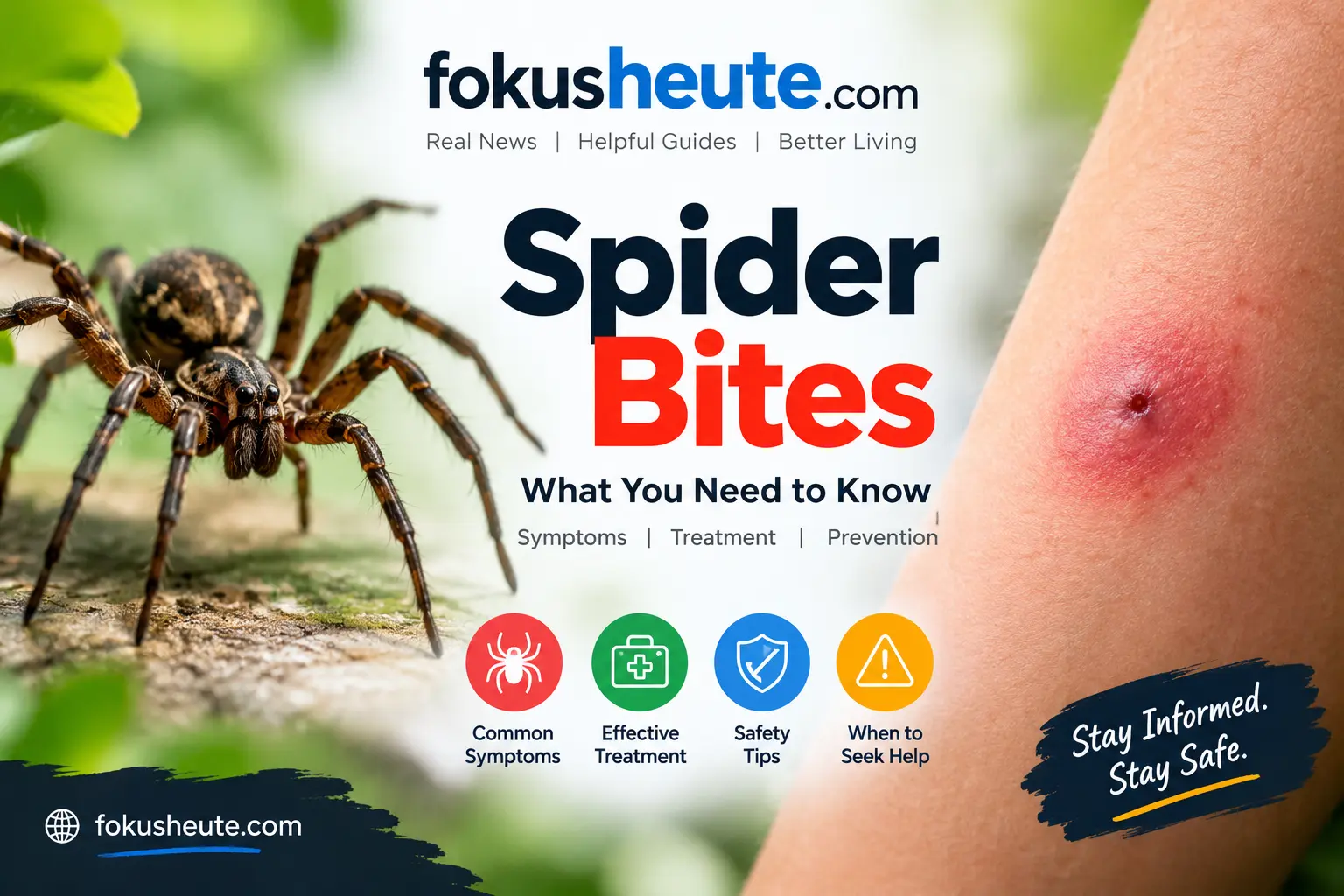
Spider bites are usually minor, but some can cause significant pain, tissue damage, or whole-body symptoms. Knowing what spider bites look like, how symptoms develop, and when medical care is necessary can help you respond appropriately without panicking.
If you notice a new red or swollen skin lesion, do not automatically assume spider bites are responsible. Many insect bites, bacterial skin infections, allergic reactions, and other skin conditions can look similar. In fact, unless a spider is seen biting you, it can be difficult to confirm the cause from the skin appearance alone.
The good news is that most cases can be managed with basic wound care and observation. The important exception is a suspected bite from a medically significant species, especially when severe pain, abdominal cramping, breathing problems, a rapidly worsening wound, or other systemic symptoms develop.
What Are Spider Bites?
A spider bite occurs when a spider’s fangs penetrate the skin. Spiders generally bite as a defensive response rather than because they are seeking people as prey. A bite may happen when a spider becomes trapped between skin and clothing, bedding, shoes, furniture, tools, or another object.
Most spiders are not medically dangerous to humans. Their fangs may be too small to penetrate human skin effectively, or their venom may cause little more than a localized reaction.
When venom is injected, the effects depend on the species, the amount of venom delivered, the location of the bite, and the person’s individual response. Some bites cause only a small red bump, while certain venomous species can produce severe pain, muscle cramping, tissue injury, or other systemic effects.
What Do Spider Bites Look Like?
There is no single appearance that proves a skin lesion came from a spider.
A mild reaction may look like:
- A small red bump
- Localized swelling
- Mild tenderness
- Itching
- Burning or irritation
- One or more tiny puncture marks
- A raised, inflamed area
Some bites may barely be noticeable.
More concerning changes include increasing pain, expanding swelling, blistering, discoloration, an enlarging wound, or skin that becomes dark purple, blue, brown, or black. These findings need medical assessment because they can occur with certain venomous bites or with other serious skin conditions.
A useful rule is simple: appearance alone cannot reliably identify a spider species or prove that a spider caused the lesion.
Spider Bites Symptoms
Symptoms vary considerably. A minor local reaction may include redness, swelling, itching, burning, or tenderness around the affected area.
Depending on the species and severity, other symptoms can include:
- Increasing pain
- Numbness or tingling
- Blistering
- Sweating
- Headache
- Nausea
- Vomiting
- Fever
- Chills
- Muscle cramps or spasms
- Abdominal pain
- Chest discomfort
- Tremors
- Weakness
- Difficulty breathing or swallowing
Severe symptoms are more concerning when they are widespread rather than limited to the skin around the bite. Widow spider venom, for example, can produce muscle pain and severe abdominal cramping, while recluse spider envenomation can cause progressive local tissue injury.
What Does a Spider Bite Feel Like?
A bite may feel like a sharp pinch, sting, burning sensation, or brief painful prick. Some people feel almost nothing when the skin is initially injured.
A mild local reaction can later become itchy, tender, or swollen.
With certain medically important spiders, however, pain can become much more noticeable after the initial bite. Black widow envenomation may produce severe muscle pain or abdominal cramping, while brown recluse envenomation can cause increasing pain during the first several hours.
If pain is becoming severe rather than gradually improving, particularly when accompanied by muscle cramps, vomiting, weakness, breathing difficulty, or a rapidly changing wound, seek medical attention.
How Quickly Do Symptoms Appear?
Timing depends on the cause.
A minor local reaction may become noticeable relatively quickly. Other venom effects can develop over several hours.
For a suspected black widow bite, systemic symptoms may include increasing pain, abdominal cramping, sweating, nausea, vomiting, tremors, or other muscle-related symptoms. Brown recluse reactions can initially be mild and then become more painful over the following hours.
This is why watching the affected area and your overall condition after a suspected venomous bite is important.
How Long Do Spider Bite Symptoms Last?
A mild reaction often improves within several days and many uncomplicated cases heal within about a week.
The recovery period can be much longer when there is significant tissue injury.
Black widow symptoms may last one to three days, although severity varies. A severe recluse-related wound can take weeks or even months to heal and may leave a scar.
If symptoms are steadily worsening instead of improving, do not simply wait for them to disappear.
How to Identify Spider Bites
The most reliable identification method is seeing the spider responsible and, when it can be done safely, having the spider identified by an appropriate expert.
Trying to identify a species from a red bump alone is unreliable. Many different conditions produce similar skin changes.
When evaluating a suspected bite, consider:
- Where the lesion appeared
- When symptoms started
- Whether a spider was actually seen
- Whether the person was sleeping, dressing, gardening, cleaning, or working outdoors
- Whether the lesion is becoming larger
- Whether there is increasing pain
- Whether systemic symptoms are present
- Whether similar lesions are appearing elsewhere
Do not handle a potentially dangerous spider just to obtain a specimen.
Can You Be Sure It Was a Spider Bite?
Usually, no.
This is one of the most important points about identifying suspected bites. Redness, swelling, pain, itching, blistering, and even skin ulcers are not unique to spiders.
Other possible explanations include:
- Mosquito bites
- Flea bites
- Mite bites
- Ant bites
- Biting flies
- Bed bug bites
- Allergic skin reactions
- Contact dermatitis
- Bacterial skin infections
- Burns
- Other inflammatory skin conditions
Medical professionals may use the history, physical examination, progression of symptoms, possible exposure, and—in some cases—identification of the spider to determine the most likely cause.
Spider Bites vs. Other Insect Bites
Different insects can cause overlapping symptoms, so location and appearance alone are not enough for a definite diagnosis.
Mosquito and flea bites commonly cause itching. Some insect stings are immediately painful. Spider-related reactions can also cause pain, redness, swelling, and itching, making visual identification difficult.
A cluster of itchy lesions, especially when new spots continue appearing, may have a different cause than a single lesion that developed after a suspected spider encounter.
If symptoms are unusual, severe, spreading, or accompanied by fever or significant illness, professional evaluation is more useful than trying to identify the bite from internet photographs.
Spider Bites vs. Skin Infections
A bacterial skin infection can look surprisingly similar to a suspected bite.
Watch for:
- Increasing redness
- Increasing warmth
- Worsening swelling
- Increasing tenderness
- Pus or drainage
- Red streaks extending away from the affected area
- Fever
- Chills
- Feeling increasingly unwell
A lesion that continues enlarging or becomes increasingly painful deserves medical evaluation even when no spider was seen.
The distinction matters because an infection may require treatment that is different from routine care for a minor bite.
Common Types of Spider Bites
Most spiders are not medically significant to people. However, several groups are important because their venom can cause serious illness.
Examples include:
- Black widow spiders
- Brown recluse and related recluse spiders
- Funnel-web spiders in regions where they occur
- Certain other medically important spiders depending on geography
The species that pose meaningful risks vary by country and region. A spider that is medically important in Australia, for example, is not necessarily relevant to someone living elsewhere.
Black Widow Spider Bites
Black widow spiders belong to the widow spider group and are recognized in the United States by features that can include a red marking on the underside of the abdomen. They often live in protected areas and may bite when disturbed or trapped.
Their venom primarily affects the nervous system and can cause pain that extends beyond the original bite site. The abdomen, chest, back, and other muscle groups may become painful.
Black Widow Spider Bite Symptoms
Symptoms can include:
- Pain and swelling at the bite site
- Severe muscle pain
- Abdominal cramping
- Abdominal rigidity
- Back or chest pain
- Nausea
- Vomiting
- Sweating
- Tremors
- Headache
- Weakness
Severe abdominal pain can sometimes be mistaken for another abdominal emergency, which is why the history of a suspected bite is important.
Symptoms can last one to three days, although the exact course varies.
Brown Recluse Spider Bites
Brown recluse spiders are associated primarily with particular regions, especially parts of the southern and central United States. They prefer dark, quiet, undisturbed locations.
Their venom can produce local tissue injury and, in uncommon cases, systemic illness.
One important misconception is that every skin lesion with a dark center is a brown recluse bite. A characteristic-looking wound does not prove the spider was responsible, and many other conditions can resemble recluse envenomation.
Brown Recluse Spider Bite Symptoms
Symptoms may initially be mild or barely noticeable and then become more pronounced.
Possible findings include:
- Increasing pain
- Redness
- Swelling
- Itching
- Fever
- Chills
- Body aches
- A blister
- A pale or discolored center
- Purple or blue discoloration
- A growing ulcer or open sore
- Tissue death in severe cases
Rare systemic complications can include blood-related abnormalities, kidney problems, seizures, or other serious illness. Children can experience more severe reactions.
Other Venomous Spider Bites
The medically important spiders depend heavily on geography.
Funnel-web spiders are a major example in parts of Australia. Their venom can produce rapid and potentially life-threatening neurological, muscular, cardiovascular, and respiratory symptoms.
Possible signs include:
- Tingling around the mouth
- Excessive sweating
- Drooping eyelids
- Difficulty swallowing
- Muscle spasms
- Tremors
- Rapid heartbeat
- Breathing difficulty
- Confusion
- Collapse
A suspected funnel-web bite is a medical emergency requiring immediate professional care.
Where Do Spiders Commonly Bite?
A spider can potentially bite any exposed area of skin.
However, defensive bites may happen when a spider becomes trapped against the body. Situations can include:
- Putting on clothing containing a hidden spider
- Reaching into dark storage areas
- Moving wood or debris
- Working around sheds or garages
- Disturbing webs
- Sleeping where a spider has become trapped in bedding
- Putting hands into cracks or hidden spaces
The location of a lesion does not, by itself, identify the spider responsible.
Where Do Dangerous Spiders Live?
The answer depends on geography.
Widow and recluse spiders have particular distributions, while funnel-web spiders are associated with parts of Australia. Habitat can include dark, dry, sheltered or rarely disturbed spaces such as woodpiles, sheds, garages, basements, attics, storage areas, cupboards, and cluttered spaces.
Before assuming that a particular dangerous species is responsible, check whether that species actually occurs in your region.
What Causes Spider Bites?
Most spiders bite defensively.
A bite may occur when a spider is:
- Trapped against the skin
- Accidentally pressed
- Disturbed while hiding
- Encountered inside clothing or bedding
- Contacted while moving wood, boxes, equipment, or debris
Spiders generally do not seek out humans to bite them.
Venom effects occur when a venomous species injects venom through its fangs. The severity depends on the species, venom composition, amount delivered, and the person’s response.
Who Is at Risk of Serious Reactions?
Anyone can potentially experience a serious reaction, but certain circumstances deserve particular caution.
Children may be more vulnerable to severe effects from some medically significant bites because of their smaller body size. People with significant underlying health problems may also require individualized medical advice.
Higher-risk situations include:
- A confirmed medically significant spider exposure
- Severe or rapidly increasing pain
- Widespread symptoms
- Breathing or swallowing problems
- A rapidly worsening wound
- Significant abdominal cramping
- Neurological symptoms
- Signs of infection
- A suspected funnel-web bite
What to Do After Spider Bites
First, move away from the area where the spider was encountered.
Then:
- Wash the affected skin with mild soap and water.
- Remove rings, bracelets, or other tight items near the affected area before swelling increases.
- Apply a cool compress to help reduce pain and swelling.
- Elevate an affected arm or leg when practical.
- Avoid squeezing, cutting, burning, or aggressively manipulating the wound.
- Monitor symptoms and changes in the skin.
- Seek medical attention if concerning symptoms develop.
If a dangerous spider is suspected, contact an appropriate medical service or poison-information service promptly rather than relying solely on home treatment.
Spider Bite First Aid
For a mild local reaction, basic wound care is usually the starting point.
Clean the area gently with soap and water. A cool, clean compress can be applied for around 15 minutes at a time to reduce discomfort and swelling. Elevating the affected limb can also help with swelling.
Over-the-counter pain medicine may help when it is safe for the person to take it. An antihistamine or topical anti-itch treatment may be useful when itching is the dominant symptom.
Do not place ice directly against bare skin. Wrap it in a clean cloth to reduce the risk of cold injury.
How to Treat Spider Bites at Home
Home care is generally appropriate only when the reaction is mild and there are no warning signs.
Useful measures include:
- Gentle cleansing
- Cool compresses
- Elevation for swelling
- Appropriate over-the-counter pain relief
- Appropriate anti-itch treatment
- Keeping the area clean
- Covering an open wound with a clean dressing when necessary
- Monitoring the skin for changes
Do not assume that home treatment is sufficient simply because the original mark is small. Some significant venom reactions begin with relatively subtle skin findings.
What Can You Put on Spider Bites?
For a minor itchy reaction, an appropriate anti-itch product such as calamine lotion or a suitable over-the-counter corticosteroid cream may provide relief.
For pain and swelling, cooling the area is generally more useful than applying irritating substances.
If the skin is broken, keep it clean and protected. Some medical guidance also recommends an over-the-counter antibiotic ointment for appropriate wounds, while clinicians may prescribe antibiotics when an actual bacterial infection develops.
Avoid household chemicals, harsh disinfectants, bleach, acids, heat, or other substances that can damage the skin.
Can Ice Help Spider Bites?
Yes. A cool compress or wrapped ice pack can help reduce pain and swelling from a minor local reaction.
Do not place ice directly against the skin. Use a cloth barrier and apply it for limited periods, allowing the skin to warm between applications. Mayo Clinic recommends a cool cloth for about 15 minutes each hour for suspected spider bites.
Cooling the skin is supportive care; it does not neutralize venom.
Should You Pop a Spider Bite Blister?
No. Avoid intentionally popping or cutting a blister.
The intact skin provides a natural barrier against bacteria. Opening it unnecessarily can increase the risk of contamination and wound complications.
If a blister breaks on its own, gently clean the area and protect it with an appropriate clean dressing. A large, painful, discolored, or worsening blister should be assessed by a healthcare professional.
Do Spider Bites Need Antibiotics?
Not automatically.
Antibiotics treat bacterial infections; they do not neutralize spider venom. A clinician may recommend antibiotics when there is evidence that a wound has become infected.
Increasing redness, warmth, swelling, pain, drainage, pus, red streaks, fever, or feeling unwell can indicate infection and warrants medical assessment.
Do not start leftover antibiotics simply because a lesion resembles a bite.
For the latest, updated, and unique information, visit jalen brunson wife.
When to See a Doctor for Spider Bites
Seek medical advice when:
- Pain is severe or increasing
- The wound continues getting larger
- Swelling is significant or worsening
- The skin becomes purple, blue, brown, or black
- A blister or ulcer develops
- Fever or chills occur
- Muscle cramps or spasms occur
- Abdominal pain develops
- Vomiting or severe weakness occurs
- Red streaks spread from the wound
- Pus or drainage develops
- You suspect a medically significant spider
- You are unsure whether the exposure involved a dangerous species
Prompt evaluation is particularly important when the symptoms are changing rather than improving.
When Is a Spider Bite an Emergency?
Call your local emergency service immediately for symptoms such as:
- Trouble breathing
- Trouble swallowing
- Swelling of the mouth, tongue, face, or throat
- Fainting or severe dizziness
- Collapse
- Severe generalized symptoms
- Severe abdominal cramping associated with a suspected venomous bite
- Severe muscle spasms
- Rapidly worsening neurological symptoms
- A suspected highly dangerous species such as a funnel-web spider
Do not drive yourself if you are experiencing severe systemic symptoms.
Warning Signs of a Serious Bite
The most important warning signs are not necessarily the size of the original mark.
Pay close attention to:
Severe or spreading pain: Pain that becomes markedly worse may indicate a more significant reaction.
Rapidly increasing swelling: Especially when swelling extends beyond the original area.
Changing skin color: Purple, blue, brown, or black discoloration can indicate significant tissue injury.
Systemic symptoms: Fever, vomiting, sweating, tremors, muscle cramps, weakness, or breathing problems need attention.
Progressive wound damage: A wound that enlarges, blisters, ulcerates, or develops dark tissue should be assessed.
Breathing or swallowing difficulty: These are emergency warning signs.
Mayo Clinic specifically recommends immediate medical care for severe pain or stomach cramping, an enlarging wound, breathing or swallowing difficulty, and expanding discolored or streaking skin.
Can Spider Bites Become Infected?
Yes.
Any break in the skin can provide an entry point for bacteria. Scratching an itchy lesion can further damage the skin and increase contamination.
Infection is more concerning when redness, warmth, swelling, pain, drainage, or fever progressively increase rather than improve.
A worsening wound does not necessarily mean the original problem was a spider. Infection can also be the primary cause of a lesion that was mistakenly attributed to a bite.
Spider Bite Infection Symptoms
Possible signs of a secondary bacterial infection include:
- Increasing redness
- Expanding warmth
- Increasing swelling
- Worsening tenderness
- Pus
- Cloudy drainage
- Red streaks
- Fever
- Chills
- Increasing fatigue or feeling unwell
If these symptoms occur, medical evaluation can determine whether antibiotics or other wound treatment are needed.
How Doctors Diagnose Spider Bites
There is usually no single laboratory test that proves an ordinary skin lesion was caused by a spider.
A clinician may consider:
- Your description of the exposure
- Whether a spider was actually seen
- Where and when the event occurred
- The appearance of the lesion
- How quickly symptoms developed
- How the wound has changed
- Your general symptoms
- Local species distribution
- Possible alternative diagnoses
The clinician may also need to rule out bacterial infection, other insect bites, allergic reactions, burns, and inflammatory skin conditions.
If a spider can be identified safely without additional exposure, an expert may be able to help determine the species.
How Spider Bites Are Treated Medically
Treatment depends on the species and symptoms.
For uncomplicated cases, medical treatment may focus on:
- Wound care
- Pain control
- Itch relief
- Monitoring
- Tetanus protection when appropriate
- Treatment of secondary infection when present
More severe envenomation may require hospital monitoring, intravenous medication, treatment for muscle spasms or severe pain, supportive care, or species-specific antivenom where an appropriate product is available.
Severe wounds may require specialized wound management and follow-up.
Spider Bite Antivenom
Antivenom is not required for most cases.
It is reserved for certain serious envenomations and depends on the spider species, geographic region, severity, and availability of an appropriate antivenom.
For severe black widow envenomation, antivenom may be considered in selected cases. Mayo Clinic notes that it is generally administered intravenously and can rapidly improve severe symptoms, but it can also cause serious allergic reactions, so clinicians weigh its risks and benefits.
Funnel-web envenomation is another example where antivenom can be an important emergency treatment.
Spider Bites in Children
Children require particular attention because serious reactions to certain venomous spiders can be more severe in young patients.
Seek prompt medical advice if a child has:
- Significant or increasing pain
- Severe abdominal symptoms
- Muscle cramps
- Vomiting
- Fever
- Widespread symptoms
- A rapidly changing wound
- Breathing or swallowing difficulty
- A suspected dangerous spider exposure
Do not rely on the size of the skin mark to judge severity.
Spider Bites During Pregnancy
Pregnancy does not change the basic need to seek emergency care when serious symptoms occur.
However, pregnant people should check with their healthcare professional before taking medications for pain, itching, or inflammation, particularly if they have other medical conditions or take prescription medicines.
A suspected venomous bite accompanied by systemic symptoms should be medically assessed rather than treated solely at home.
How Long Do Spider Bites Take to Heal?
Minor reactions commonly improve over several days, with many uncomplicated cases healing in approximately a week.
Recovery from significant tissue injury is different. A recluse-related wound can take considerably longer, sometimes weeks or months, and may leave a scar.
Healing time depends on the type of reaction, depth of tissue injury, presence of infection, overall health, and treatment.
Can Spider Bites Leave Scars?
Most mild reactions do not leave significant scars.
A deeper wound involving tissue destruction can scar after healing. Severe recluse-related lesions may take months to heal and can leave noticeable scars.
Avoid picking, squeezing, or repeatedly scratching the affected area because additional skin trauma can interfere with healing.
What Happens If a Spider Bite Gets Worse?
A worsening lesion should not be ignored.
If redness expands, pain increases, swelling becomes more pronounced, a blister enlarges, the center becomes dark, drainage develops, or systemic symptoms appear, seek medical evaluation.
A worsening lesion may represent venom-related tissue injury, bacterial infection, another skin disease, or a different type of bite. The important point is that progression requires reassessment rather than assuming the original diagnosis was correct.
How to Prevent Spider Bites
Prevention focuses on reducing contact with spiders and their hiding places.
Helpful measures include:
- Shake out clothing and shoes that have been stored
- Wear gloves when moving wood or debris
- Avoid placing hands into dark crevices
- Reduce clutter in storage areas
- Keep sleeping areas free from unnecessary clutter
- Inspect sheds and garages
- Use caution when moving boxes or stored materials
- Seal cracks and gaps where practical
- Keep outdoor work areas organized
- Use appropriate protective clothing when working in known spider habitats
Workers who regularly enter spider habitats should take additional precautions because occupational exposure can occur around woodpiles, storage areas, equipment, and outdoor structures.
How to Keep Spiders Out of Your Home
Reducing suitable hiding places can make encounters less likely.
Practical steps include:
- Seal gaps around doors and windows
- Repair damaged screens
- Reduce clutter
- Store boxes away from sleeping areas
- Keep storage spaces organized
- Clean webs when it is safe to do so
- Keep firewood away from living areas where practical
- Inspect rarely used clothing and shoes
- Address cracks and other entry points
If a home has a persistent spider problem involving potentially dangerous species, professional pest management may be appropriate.
How to Avoid Spider Bites at Work and Outdoors
People working outdoors, handling wood, cleaning storage buildings, gardening, or entering rarely disturbed spaces should use reasonable protective measures.
Wear gloves when appropriate, inspect clothing and footwear, and avoid placing bare hands into holes, woodpiles, debris, or dark spaces where spiders may be hiding.
CDC guidance for outdoor workers emphasizes that most medically important spider encounters happen when a spider is trapped or touched rather than because spiders actively seek people.
What to Do If You Find a Spider in Your Home
Do not grab an unfamiliar spider with your bare hands.
If it can be removed safely, use a method that keeps your hands away from the animal. For potentially dangerous species, consider professional pest control rather than attempting close handling.
If someone has already been bitten, do not take unnecessary risks trying to capture the spider. A clear photograph taken from a safe distance may sometimes help with identification, but medical care should never be delayed while attempting to obtain evidence.
Common Myths About Spider Bites
Myth: Every painful red bump is a spider bite.
Not true. Many insect bites, infections, and skin conditions can produce similar lesions.
Myth: A bite with two puncture marks proves it came from a spider.
Puncture-like marks are not enough to establish the cause.
Myth: A spider bite always hurts immediately.
Some bites may initially cause little discomfort, while symptoms can develop later.
Myth: All spiders are dangerous to humans.
Most spiders do not cause serious human illness.
Myth: You should cut open a venomous bite to remove the venom.
Cutting the skin can cause additional injury and does not provide a safe method of removing venom.
Myth: Antibiotics treat spider venom.
Antibiotics target bacterial infections. They do not neutralize venom.
Myth: A dark center automatically means a brown recluse caused the lesion.
Many different skin problems can develop dark or ulcerated centers. Species identification and clinical assessment are more reliable than appearance alone.
FAQs
What are the most common symptoms of spider bites?
Common local symptoms include redness, swelling, itching, tenderness, burning, and pain. More serious envenomation can cause muscle cramps, abdominal pain, nausea, vomiting, sweating, tremors, fever, or other systemic symptoms.
How can you tell if a skin lesion came from a spider?
You often cannot tell with certainty from the lesion alone. Seeing the spider bite you and obtaining reliable species identification provides much stronger evidence. Other insects, infections, allergic reactions, and skin conditions can look similar.
Are spider bites dangerous?
Most are not serious, but certain medically important species can cause significant illness. Severe pain, abdominal cramping, breathing problems, rapidly progressive wounds, neurological symptoms, or widespread illness require prompt medical attention.
What should you do immediately after a suspected bite?
Wash the area with soap and water, apply a cool compress, elevate the affected limb when practical, and monitor symptoms. Seek urgent medical care when severe or rapidly worsening symptoms occur.
Can you treat a mild reaction at home?
A mild local reaction can often be managed with cleaning, cooling, appropriate pain relief, and itch control. Continue monitoring the area for worsening pain, spreading redness, infection, or other concerning changes.
How long does it take for a minor bite to heal?
Many uncomplicated cases improve within several days and heal in roughly a week. More significant tissue injuries can take substantially longer.
Can a suspected bite become infected?
Yes. Any break in the skin can become infected. Increasing redness, warmth, swelling, pain, pus, drainage, red streaks, fever, or chills should prompt medical assessment.
Should you pop a blister?
No. It is generally better to leave a blister intact because the skin helps protect the underlying tissue from contamination.
Can ice reduce swelling?
A wrapped cold pack or cool compress can reduce pain and swelling. Do not put ice directly on bare skin.
Do spider bites need antibiotics?
Not necessarily. Antibiotics are used when a bacterial infection is present or strongly suspected; they do not treat venom itself.
When should you go to the emergency room?
Seek emergency help for difficulty breathing or swallowing, facial or throat swelling, collapse, severe generalized symptoms, severe muscle spasms, or other rapidly developing systemic symptoms. A suspected bite from a highly dangerous species also warrants urgent professional assessment.
What does a black widow bite feel like?
The initial bite may cause local pain, but significant envenomation can produce severe muscle pain, abdominal cramping, sweating, nausea, vomiting, tremors, and other symptoms.
What does a brown recluse reaction look like?
A reaction can begin with mild pain and later develop increasing pain, redness, blistering, discoloration, and sometimes tissue injury or ulceration. However, appearance alone cannot prove that a brown recluse caused the lesion.
Can a bite cause fever?
Yes. Fever can occur with some significant venom reactions, but it can also indicate infection or another illness. Persistent or significant fever should be evaluated.
Can a bite cause muscle cramps?
Yes. Muscle cramping is particularly associated with significant widow spider envenomation. Severe abdominal or generalized muscle cramping should receive prompt medical attention.
Can a bite leave a permanent scar?
Most minor reactions do not. Deep tissue injury can leave a scar, particularly when an ulcer develops or substantial tissue damage occurs.
What should you do if you are unsure which spider caused the bite?
Do not attempt to handle a spider to obtain an identification. Document the time and circumstances, monitor symptoms, and seek medical advice if the reaction is severe, progressive, or associated with systemic symptoms.
Conclusion
Most suspected spider bites are minor and improve with simple supportive care, but not every red or swollen skin lesion is actually caused by a spider. That distinction is important because insect bites, bacterial infections, allergic reactions, and other skin conditions can look remarkably similar.
The safest approach is to clean the affected area, use a cool compress for discomfort and swelling, avoid damaging the skin, and monitor how the reaction changes. Severe pain, significant abdominal cramping, breathing or swallowing difficulty, rapidly expanding swelling, progressive tissue damage, neurological symptoms, or signs of infection should not be ignored.
Knowing the local spider species, recognizing warning signs, and getting medical help when symptoms are severe or worsening can make the difference between routine home care and a situation that needs urgent treatment.
For the latest, updated, and unique information, visit best colleges for computer science.


2 thoughts on “Spider Bites: Symptoms, Treatment, Warning Signs & First Aid Guide”