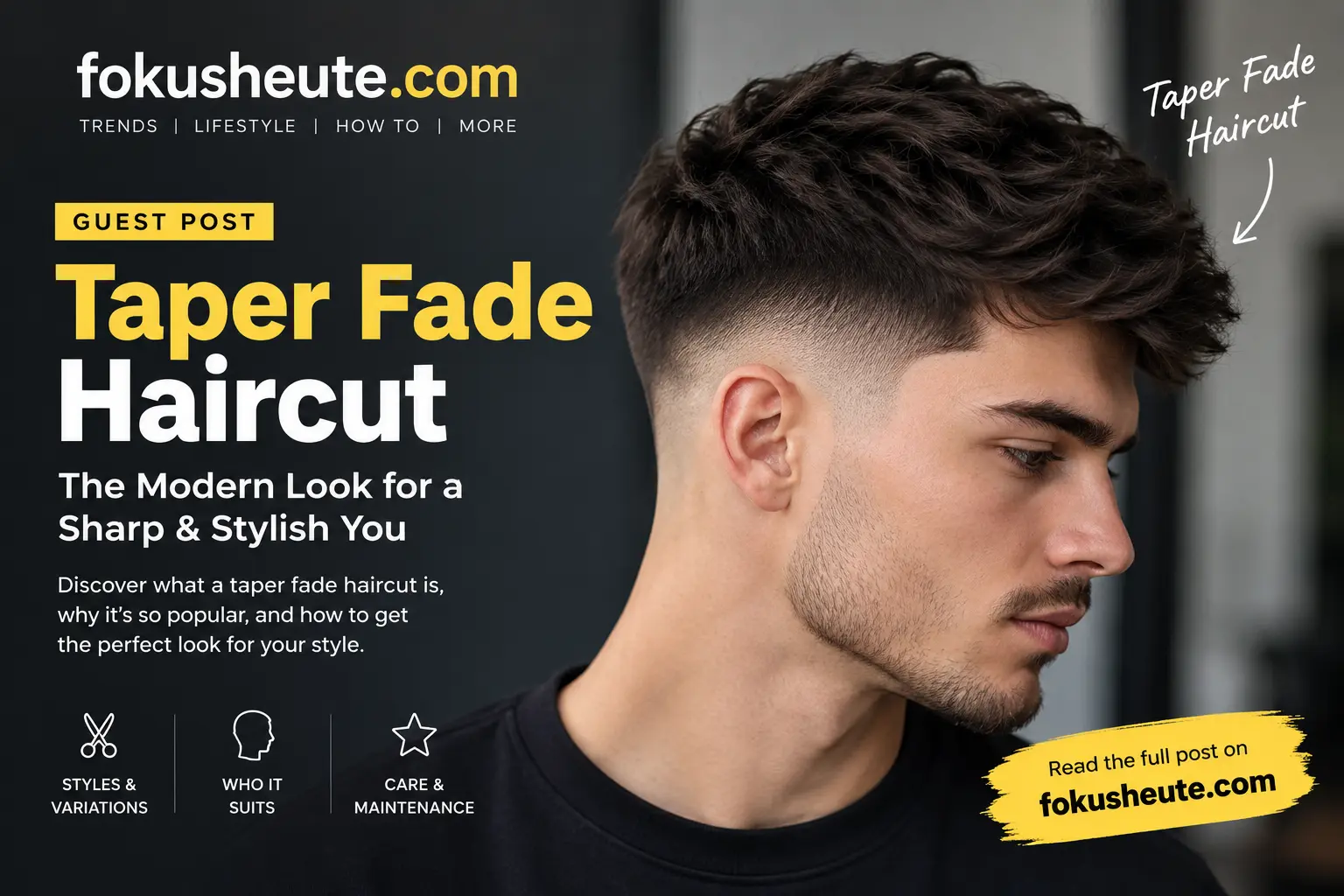
A taper fade haircut is one of the most adaptable men’s hairstyles because it can be subtle around the edges or noticeably sharper while leaving plenty of freedom on top. A taper fade haircut can work with straight, wavy, curly, or coily hair and can be adapted to different face shapes, hairlines, workplaces, and personal styles.
If you are completely new to fades, the terminology can be confusing. What does “low,” “mid,” or “high” actually mean? Is a taper the same as a fade? Does a skin finish always mean the same thing as a high fade? How should you explain what you want to a barber?
The key is understanding that placement, shortest finish, top length, texture, and styling are separate decisions. Once you understand those five elements, choosing a haircut becomes much easier.
In this guide, you will learn how the cut works, the differences between taper variations, which styles work with different hair types and face shapes, how to communicate with your barber, how to maintain the look, and what men’s grooming trends are influencing taper styles in 2026.
What Is a Taper Fade Haircut?
A taper fade gradually reduces hair length around selected areas, usually the temples, sideburns, ears, and neckline, rather than removing the same amount of hair from the entire side of the head.
The transition is created by blending different lengths so there is no obvious step between one length and another. The hair can remain relatively full through the upper sides and top while becoming progressively shorter around the perimeter.
A useful way to understand the structure is:
- Top: usually retains the most length.
- Upper sides: may retain substantial weight depending on the style.
- Temples: can be gradually shortened.
- Sideburns: are blended into the surrounding hair or beard.
- Neckline: is tapered or cleaned to create a controlled finish.
- Lowest point: can be a shadow, very short clipper finish, or skin, depending on the requested result.
The terminology is not perfectly standardized between barbershops. “Low,” “mid,” and “high” generally describe the location of the blend, while the shortest finish is a separate choice.
How Does a Taper Fade Haircut Work?
The barber creates a gradient by moving between progressively shorter lengths.
A typical blending process involves:
- Establishing the desired taper height.
- Creating a guideline around the temple, sideburn, or neckline.
- Removing bulk below or around that guideline.
- Using different clipper guards to transition between lengths.
- Using a lever adjustment for finer blending.
- Checking the blend from multiple angles.
- Detailing the hairline, sideburns, and neckline.
- Styling the top to reveal the final shape.
The quality of the result depends heavily on blending technique, head shape, hair density, growth pattern, and the barber’s ability to control weight.
A good blend should look gradual rather than like several visible bands of hair.
What actually creates the faded appearance?
The visual effect comes from a controlled change in hair density and length. Darker, longer areas gradually transition into shorter, lighter-looking areas. On very short finishes, the scalp becomes increasingly visible.
This is why two people can request the same taper height but receive slightly different-looking results. Their hair density, texture, scalp visibility, and head shape are not identical.
Taper Fade vs Taper vs Fade: What Is the Difference?
The three terms overlap in everyday barber language, but they can describe different amounts and locations of hair removal.
A traditional taper usually preserves more length through the sides and focuses on gradually shortening the edges around the sideburns and neckline.
A fade generally creates a more noticeable reduction of length through a larger portion of the sides and back. Depending on the type, the transition may reach very short or skin-level lengths.
A taper fade sits between these concepts in common usage: it emphasizes a gradual transition around specific areas while allowing considerable length to remain elsewhere.
The important point is that terminology varies between shops. Instead of relying entirely on a label, describe:
- Where you want the blend to begin.
- How much weight you want left on the sides.
- Whether you want visible scalp.
- How short you want the lowest point.
- How much length you want on top.
- Whether you want a soft or high-contrast transition.
A reference photograph is often more precise than a haircut name.
Low Taper Fade vs Mid Taper Fade vs High Taper Fade
The biggest distinction between low, mid, and high versions is where the shorter transition begins.
| Type | General placement | Visual effect |
|---|---|---|
| Low taper | Close to ears and neckline | Subtle, natural |
| Mid taper | Around the middle/temple area | Balanced, defined |
| High taper | Higher on the sides | Stronger contrast |
These are directional categories rather than exact measurements. A barber may position the transition slightly differently according to your head shape, hair density, and desired silhouette. Current 2026 barber guides also emphasize that taper height and shortest finish should be discussed separately.
What Is a Low Taper Fade?
A low taper keeps the shortest area close to the lower perimeter of the head, particularly around the ears, sideburns, and neckline.
Because most of the side remains fuller, the result tends to be understated. It is particularly useful if you want a clean appearance without dramatically changing the shape of your hair.
It can be combined with:
- Textured crops
- Side parts
- Quiffs
- Curls
- Waves
- Longer tops
- Short crops
- Beards
- Classic men’s hairstyles
A low taper is also useful for someone trying a fade for the first time because the change is relatively localized.
What Is a Mid Taper Fade?
A mid taper moves the transition higher than a low taper, generally around the middle of the sides or temple region.
This creates more visible definition while still allowing substantial length to remain higher on the head.
It works particularly well when you want a haircut that can move between casual and polished settings. The same foundation can support a textured top, comb-over, curls, waves, quiff, or slick-back style.
The exact position should be confirmed visually because “mid” does not represent an identical measurement on every head.
What Is a High Taper Fade?
A high taper begins the shorter transition higher on the sides, creating stronger contrast between the upper hair and the shortened sides.
It can produce a more noticeable, contemporary silhouette, particularly when paired with textured or voluminous hair on top.
However, the higher the transition goes, the more it can alter the perceived width and height of the hairstyle. If you are unsure, show your barber exactly where you want the transition rather than relying only on the word “high.”
What Is a Low-Mid Taper Fade?
A low-mid taper occupies the space between a conventional low and mid placement.
It can provide more definition than a low taper while retaining more side weight than a higher fade. This makes it useful when you want a visible blend without dramatically changing the upper side profile.
Current 2026 styling coverage frequently describes this middle placement as a practical option because it can work with different top styles and hair textures.
Does Taper Height Change How Short the Hair Gets?
No. Taper height and shortest length are two separate decisions.
For example, you can have:
- A low taper with a skin finish.
- A low taper with a shadow finish.
- A mid taper with a short guard finish.
- A high taper that does not reach completely bare skin.
This distinction is extremely important when talking to a barber.
If you only say “high taper,” your barber still does not know whether you want a skin, shadow, or clipper finish.
Instead, specify both:
“Keep the taper low around my temples and neckline, and make the bottom a soft shadow rather than exposing the skin.”
That gives the barber two separate instructions.
Skin Taper Fade vs Shadow Taper Fade
A skin taper blends down to the scalp, creating maximum contrast at the shortest point.
A shadow taper leaves a small amount of visible hair at the bottom, creating a softer and less exposed appearance.
Skin finish
A skin finish can look extremely crisp and high-contrast. It is useful when you want a fresh, sharp appearance.
However, scalp visibility, skin tone, hair density, and growth speed can influence how noticeable the finish becomes.
Shadow finish
A shadow finish is softer because a small amount of hair remains. It can be useful if you want the clean appearance of a fade without a completely exposed scalp.
Neither finish is automatically better. The right choice depends on the amount of contrast you want and how frequently you want to maintain it.
Temple Taper Fade vs Neck Taper Fade
A temple taper concentrates the transition around the temples and sideburn area.
A neck taper emphasizes the neckline and nape.
Many modern cuts combine both areas, creating a connected perimeter finish.
The distinction matters when you want to preserve more hair around one area. For example, someone with a beard may want the sideburn transition carefully blended into facial hair while keeping the neckline relatively natural.
Burst Taper Fade vs Traditional Taper Fade
A burst taper fade creates a curved, radiating transition around the ear rather than following a simple narrow taper around the entire perimeter.
It is particularly associated with hairstyles where the area around the ear needs visual separation, including curly styles, mohawks, mullets, and textured cuts.
A traditional taper generally has a more restrained perimeter transition.
The burst variation is therefore less about simply making the hair shorter and more about shaping the area around the ear to support the hairstyle above it.
Drop Taper Fade: What Makes It Different?
A drop fade follows the natural curvature of the head and drops lower toward the back.
It is more of a fade-shape concept than a simple taper-height instruction.
This distinction matters because a drop effect can change the silhouette at the back of the head. If you want the back to follow the natural curve rather than maintain a relatively level transition, tell your barber.
Best Taper Fade Haircut Styles for Men
The foundation can be paired with almost any top length and texture.
Popular combinations include:
- Textured crop
- Quiff
- Pompadour
- Side part
- Slick back
- Fringe
- Mullet
- Waves
- Curls
- Buzz-style tops
- Comb-over
- Messy textured styles
- Longer layered tops
The sides do not determine the entire hairstyle. The top shape, texture, volume, fringe direction, and styling product can completely change the finished appearance.
Taper Fade With a Textured Crop
A textured crop combines short-to-medium hair on top with separated texture and a controlled perimeter.
The taper keeps the edges clean while the textured top provides movement.
For straight or thick hair, a matte clay or texture paste can help create separation. For naturally curly hair, a curl cream can preserve definition without making the top look overly stiff.
Taper Fade With a Quiff
A quiff keeps the front and upper hair longer so it can be lifted and directed backward.
The contrast between a controlled taper and a voluminous top can make the haircut look structured without requiring extremely short sides.
Hair density matters here. Fine hair may benefit from lightweight volumizing products, while thick hair may need stronger styling support.
Taper Fade With a Pompadour
A pompadour requires more volume and direction through the front and upper portion of the hair.
Because the top is visually dominant, the sides need to be shaped carefully so the overall silhouette remains balanced.
A blow dryer can be more important than heavy styling products because heat and directional airflow help establish the volume before finishing product is applied.
Taper Fade With a Side Part
A side part offers a classic appearance while the tapered perimeter keeps the edges modern.
It works particularly well with straight and wavy hair, although curly hair can also be styled with a defined part if the natural curl pattern permits it.
A comb, light pomade, or styling cream can help establish the part without making the hair excessively rigid.
Taper Fade With Slicked-Back Hair
A slick-back requires enough length on top to direct the hair toward the back.
A taper around the sides keeps the hairstyle controlled without forcing the entire head into a very short cut.
For a modern finish, a low-shine or matte product can create separation. For a traditional glossy appearance, a higher-shine pomade can be used.
Taper Fade With a Fringe
A fringe leaves length toward the forehead and can be worn straight, textured, curly, or slightly messy.
The advantage of combining a fringe with a taper is that the front can remain visually strong while the sides stay controlled.
Fringe length should be chosen according to hair texture and how much forehead coverage you want.
Taper Fade With a Mullet
A mullet keeps additional length toward the back while the sides and perimeter are controlled.
The taper can make the transition around the temples and ears cleaner without removing the defining length at the rear.
A burst-style transition is also commonly paired with mullet-inspired cuts because it creates more shape around the ear.
Taper Fade With Waves
Waves rely on hair direction, length, texture, brushing technique, and consistent maintenance.
A taper around the perimeter creates contrast between the patterned hair and the clean edges.
Because wave patterns vary significantly between individuals, the barber should avoid removing too much from areas where you need sufficient length to maintain the pattern.
Taper Fade With Curly Hair
Curly hair can produce a particularly strong contrast between defined curls on top and shorter sides.
The most important factors are curl pattern, shrinkage, density, and moisture.
The barber should understand how the curls behave when dry, because wet hair can appear substantially longer and different from its final dry shape.
Taper Fade With a Beard
The sideburn area creates a natural connection between scalp hair and facial hair.
A barber can gradually blend the sideburn into the beard or create a deliberate separation.
The beard neckline should also be considered. A clean haircut paired with an unstructured beard can create a disconnected appearance unless that contrast is intentional.
Best Taper Fade for Straight, Wavy, Curly, and Coily Hair
There is no single version that universally works for every texture.
Hair type changes:
- How the blend appears.
- How much volume remains.
- How quickly bulk becomes visible.
- How much styling is needed.
- How the haircut grows out.
- How the top should be shaped.
The best approach is to choose the taper placement and then adapt the top to your natural texture rather than fighting it.
Taper Fade Haircut for Straight Hair
Straight hair makes the graduation highly visible, so blending quality matters.
A low taper can preserve weight around the sides, while a mid or high taper can create stronger contrast.
Straight hair also works well with:
- Side parts
- Quiffs
- Slick backs
- Textured crops
- Fringes
- Comb-overs
If the hair is very fine, avoid removing too much density from the sides because excessive contrast can make the top appear thinner.
Taper Fade Haircut for Wavy Hair
Wavy hair naturally creates movement and volume.
A taper allows the waves to remain the primary visual feature while keeping the perimeter tidy.
Medium-length waves can be particularly versatile because they can be worn naturally, pushed back, separated with styling cream, or shaped into a textured top.
Taper Fade Haircut for Curly Hair
Curly hair requires attention to shrinkage and curl distribution.
A barber should assess the hair’s natural pattern before deciding how much length to remove.
A tighter taper can make curls appear more prominent because the shorter sides create visual contrast.
Moisture is also important. Over-drying curly hair can produce frizz and reduce definition.
Taper Fade Haircut for Coily and Afro-Textured Hair
Coily and Afro-textured hair can support sharp perimeter work, waves, curls, sponge twists, textured tops, and other styles.
The barber should account for density, curl pattern, shrinkage, and the natural direction of growth.
The goal is not simply to make the sides as short as possible. Shape and proportion matter just as much.
For highly textured hair, communication about the desired silhouette is especially useful because the same taper height can look substantially different at different densities.
Taper Fade for Thick Hair
Thick hair provides plenty of styling options but can create unwanted bulk around the sides.
A taper can remove some of that visual weight while preserving volume on top.
If your hair becomes bulky quickly, ask your barber whether the sides need weight removal beyond the actual taper area.
Do not automatically request an aggressive fade simply because your hair is thick. Sometimes controlled texturizing is enough.
Taper Fade for Fine or Thin Hair
Fine hair requires careful balance.
Removing too much from the sides can make the top appear disproportionately thin. A softer taper can preserve the impression of density.
Texture can also help. A short textured top may make fine hair look fuller than a flat, heavily combed style.
For visible thinning, communicate your priority clearly: preserving density, minimizing contrast, or creating the appearance of more volume.
Best Taper Fade Haircut for Every Face Shape
Face shape should be treated as a design reference, not a strict rulebook.
The goal is to balance proportions through the relationship between:
- Side width
- Top height
- Hairline shape
- Fringe length
- Beard volume
- Taper placement
- Overall silhouette
Your actual head shape and hair growth pattern are often more important than a simple face-shape label.
Taper Fade for Round Faces
A round face generally has similar width and length with softer angles.
Adding controlled height on top can visually lengthen the overall silhouette.
A textured quiff, pompadour, or higher-volume top can create more vertical structure, while excessive side bulk may make the face appear wider.
Taper Fade for Oval Faces
Oval faces are naturally versatile because the proportions tend to be balanced.
Many taper heights can work, including low, mid, and higher placements.
The bigger decision is usually the preferred top style rather than whether the face can handle a particular taper.
Taper Fade for Square Faces
Square faces have more pronounced jaw and forehead width.
A clean taper can complement those stronger angles.
You can choose between a structured top for a sharper appearance or textured volume for a softer effect.
The beard can also influence the final shape significantly.
Taper Fade for Heart-Shaped Faces
Heart-shaped faces often have a wider forehead with a narrower chin.
A style that maintains controlled width around the sides and adds appropriate texture through the top can help balance the proportions.
Avoid choosing a haircut solely from a generic face-shape chart. Hairline position and natural density can change the result considerably.
Taper Fade for Diamond Faces
Diamond-shaped faces often have stronger cheekbone width with narrower forehead and jaw areas.
Texture and moderate volume can help create balance.
A side part, textured fringe, or controlled curly top can work well depending on the individual’s hair.
Taper Fade for Oblong and Long Faces
Longer faces already have strong vertical proportions.
Excessive height on top can emphasize that length. A lower taper and moderate top volume can create a more balanced silhouette.
A textured fringe can also visually reduce the amount of vertical space.
How to Choose the Right Taper Fade Haircut
Start with five questions:
- How much side weight do you want to keep?
- Where should the taper begin?
- How short should the lowest point be?
- How much length do you want on top?
- How much maintenance are you willing to do?
Then consider your hair texture, growth pattern, face proportions, workplace requirements, beard, and preferred styling routine.
This approach is more reliable than choosing a haircut simply because it looks good on someone else.
How to Choose Between a Low, Mid, and High Taper
Choose a low taper when you want subtle edge cleanup and more retained side weight.
Choose a mid taper when you want a visible but balanced transition.
Choose a high taper when you want stronger contrast and less weight higher on the sides.
If you are unsure, ask your barber to demonstrate the approximate transition height before the clippers go in.
Remember that going shorter or higher is easier than reversing an aggressive cut. Hair has to grow back before a different shape can be created.
How to Choose the Right Fade Finish
Think separately about the lowest point:
Skin: maximum scalp exposure and contrast.
Shadow: soft, lightly visible hair at the bottom.
Clipper finish: short but visibly retained hair.
If you prefer a natural appearance, a shadow or longer clipper finish may be easier to live with between appointments.
If you want maximum sharpness, a skin finish creates a stronger visual difference.
For the latest, updated, and unique information, visit best colleges for computer science.
How to Choose the Right Taper Fade for Your Hairline
Your hairline affects the way the haircut frames your face.
Consider:
- Receding temples
- Widow’s peak
- Uneven hairline
- Cowlicks
- High forehead
- Low forehead
- Curved hairline
- Uneven density
A good barber should work with the natural hairline instead of forcing an artificial shape.
Can a Taper Fade Work With a Receding Hairline?
Yes, but the design should account for where the hair is thinning.
A taper can clean the temples without necessarily drawing excessive attention to them. The top can then be styled according to the remaining density.
A shorter textured style may make uneven density less obvious than a slick style that exposes every section of the hairline.
The important objective is to create a deliberate shape rather than trying to hide every sign of natural hairline change.
Can a Taper Fade Make Your Face Look Longer or Wider?
It can influence perceived proportions, although it does not physically change face shape.
More height on top can create a longer visual silhouette.
More retained width around the sides can make the hairstyle appear fuller horizontally.
A higher taper removes more side weight, while a lower taper tends to preserve more of it.
The top, beard, fringe, and taper should therefore be considered together.
How to Ask Your Barber for a Taper Fade
Avoid saying only:
“Give me a taper.”
Instead, explain the haircut in components.
For example:
“Keep the top around this length, keep most of the side weight, start the taper low around the temples and neckline, and blend it softly without taking it down to bare skin.”
If you want a different finish:
“Keep the same taper placement, but take the bottom down to skin.”
A photograph should support your explanation rather than replace it.
What Should You Tell Your Barber Before Getting a Taper Fade?
Tell the barber:
- Your preferred taper height.
- Desired shortest finish.
- Top length.
- Whether you want to keep side weight.
- Whether you want a hard or soft contrast.
- Your normal styling routine.
- Whether you wear a beard.
- How often you can return for maintenance.
- Any workplace or school restrictions.
- Any areas of your hairline you want handled carefully.
Also tell them what you do not want.
For example:
“I don’t want the fade to climb too high.”
That sentence can prevent a major misunderstanding.
How to Use Reference Photos to Get the Exact Taper You Want
Bring two or three useful photographs rather than one heavily edited image.
Ideally include:
- Front view
- Side view
- Back view
Look for photographs with similar hair texture and density.
Do not assume the haircut will look identical simply because the reference model has the same face shape. Hair thickness, curl pattern, head shape, and hairline all affect the result.
Show your barber the exact part you like: taper height, top length, neckline, texture, or side profile.
How Long Should the Top Be With a Taper Fade?
There is no universal top length.
A short textured crop may need only a few centimeters of working length, while a pompadour or slick-back requires considerably more.
Your top length should be determined by:
- Hair texture
- Desired hairstyle
- Hair density
- Styling ability
- Face proportions
- Amount of daily maintenance
The top does not have to be dramatically long for the haircut to look modern.
How to Maintain a Taper Fade Haircut
Maintenance involves more than returning to the barber.
Keep the scalp and hair clean according to your hair type, avoid excessive heat, use suitable styling products, and protect curly or coily hair from unnecessary dryness.
At home:
- Use shampoo according to your scalp needs.
- Condition when appropriate.
- Avoid applying excessive product.
- Brush or comb according to your hairstyle.
- Use a blow dryer carefully when creating volume.
- Keep facial hair coordinated with the haircut.
- Avoid attempting aggressive self-fading without the necessary skill.
For curly and coily hair, moisture and gentle handling can be particularly important.
How Often Should You Get a Taper Fade?
The ideal schedule depends on how quickly your hair grows and how precise you want the edges to remain.
Many people schedule maintenance somewhere around two to four weeks, while others allow the cut to grow longer for a softer appearance. Current 2026 barber guides commonly cite approximately two to four weeks depending on taper height and desired sharpness.
A skin-level finish generally shows regrowth more clearly than a softer shadow finish.
If you want the edges extremely crisp, you may need more frequent touch-ups.
How Long Does a Taper Fade Last?
The haircut does not suddenly stop looking good after a fixed number of days.
Instead, the visual transition gradually becomes less defined as the hair grows.
Factors include:
- Hair growth rate
- Taper height
- Starting length
- Skin versus shadow finish
- Hair density
- Curl pattern
- Desired level of sharpness
Someone who likes a natural grown-in look may keep the haircut longer than someone who wants freshly detailed edges.
How Does a Taper Fade Grow Out?
A softer taper usually grows out gradually because there is no large block of extremely short hair extending high up the sides.
A skin finish can reveal regrowth more quickly because even a small amount of new hair becomes visible against the scalp.
As the haircut grows, the contrast between the top and sides decreases.
You can either return for a full haircut or ask for an edge cleanup if the overall length is still working for you.
How to Style a Taper Fade Haircut
Start with clean, towel-dried hair.
Then:
- Apply the appropriate pre-styling product if needed.
- Use a blow dryer to establish direction and volume.
- Work a small amount of styling product through the hair.
- Build texture with your fingers or a comb.
- Finish with only enough product to hold the desired shape.
The product should support the haircut rather than burying the natural texture.
For a textured crop, use a matte product.
For a slick-back, use a cream, pomade, or styling product appropriate to the desired shine.
For curls, prioritize definition and moisture.
Best Hair Products for Styling a Taper Fade
The haircut itself does not require one specific product.
Choose according to the top hairstyle:
Matte clay: strong texture and separation.
Texture paste: flexible definition with a natural appearance.
Pomade: useful for controlled styles such as side parts and slick backs.
Styling cream: useful for softer, more natural movement.
Curl cream: helps define curls and reduce unwanted frizz.
Hair mousse: can provide lightweight volume for fine or wavy hair.
Sea salt spray: can add texture and volume but should not be overused on dry hair.
Heat protectant: important when regularly using a blow dryer or other heat tools.
Common Taper Fade Haircut Mistakes to Avoid
Choosing the haircut from a photograph alone
The same haircut can look completely different on another head.
Confusing taper height with shortest length
Saying “low” does not automatically mean “skin,” and saying “high” does not automatically mean “zero.”
Removing too much side weight
This can change the entire silhouette.
Ignoring hair texture
Curly, coily, wavy, straight, thick, and fine hair respond differently to the same cut.
Choosing a style that requires more maintenance than you want
A very sharp finish may require frequent appointments.
Giving the barber vague instructions
“Make it clean” is subjective. Describe placement, length, finish, and top style.
Using too much styling product
Heavy product can make fine hair look flatter and curly hair look weighed down.
Trying to copy a celebrity or influencer exactly
The better approach is to identify the specific elements you like and adapt them to your own hair.
Taper Fade Haircut vs Low Fade
A low fade generally describes a fade that begins low on the sides, while a low taper usually concentrates the shortening more narrowly around the perimeter.
The amount of hair removed from the upper sides can therefore be different.
If you want to retain substantial side weight, be explicit about that when requesting a low taper.
Taper Fade Haircut vs Mid Fade
A mid fade generally removes more side weight across the middle portion of the head.
A mid taper can keep more surrounding length while concentrating the taper around the relevant perimeter areas.
The distinction becomes especially important when you want a textured or longer top with visible side fullness.
Taper Fade Haircut vs High Fade
A high fade takes the transition higher and can remove a substantial amount of side weight.
A high taper can also be placed high, but the intended design may remain more localized than a conventional full-side high fade.
Always show your barber where you want the transition.
Taper Fade Haircut vs Skin Fade
A skin fade describes the shortest finish, not necessarily the height.
A skin fade can be low, mid, or high depending on where the transition begins.
Therefore, “skin” answers the question how short?, while “low/mid/high” answers where?
This is one of the most useful distinctions to understand before visiting a barber.
Taper Fade Haircut vs Drop Fade
A drop fade follows the head’s curvature and typically drops lower toward the back.
A taper can be designed around the perimeter without necessarily creating the same pronounced drop.
The choice depends on the silhouette you want from the side and rear.
Taper Fade Haircut vs Burst Fade
A burst fade creates a curved transition around the ear and is often used to emphasize a mohawk, mullet, curly top, or other specialized silhouette.
A conventional taper is usually more restrained.
If your goal is to preserve more of the natural side profile, tell the barber whether you want a localized perimeter taper or a larger curved fade around the ear.
Is a Taper Fade Professional for Work or School?
A low or moderate taper can be adapted to conservative environments because the transition can remain subtle and the overall silhouette can stay neat.
However, dress codes vary by workplace, school, profession, and country.
If you have formal grooming requirements, check the actual policy rather than assuming a particular haircut is permitted.
For a conservative environment, you can request:
- Lower taper placement
- Softer blending
- Moderate top length
- Natural neckline
- Limited scalp exposure
- Controlled styling
Is a Taper Fade Good for First-Time Fade Wearers?
It can be a practical starting point because you can control both the taper height and the shortest finish.
A low taper with a shadow finish produces a relatively subtle change.
If you later want more contrast, the barber can move the transition higher or shorten the finish during a future appointment.
This is generally easier than starting with an aggressive cut and waiting for the hair to grow back.
How Much Does a Taper Fade Haircut Cost?
The price varies substantially by country, city, barber experience, shop type, and service level.
A neighborhood barbershop, premium men’s salon, celebrity barber, and high-end grooming studio can all charge different prices for similar terminology.
Additional services may also change the total, including:
- Beard shaping
- Hot towel treatment
- Shampoo
- Styling
- Line-up
- Facial treatment
- Premium barber consultation
Before booking, ask for the complete price rather than assuming the haircut name includes every service.
How to Find a Good Barber for a Taper Fade Near You
Start by checking recent examples of the barber’s actual work.
Look specifically for:
- Side-profile photographs
- Back-of-head photographs
- Consistent blending
- Clean neckline work
- Natural transitions
- Similar hair textures to yours
- Similar top lengths
- Beard integration if relevant
Reviews can provide useful context, but photographs of comparable hair are particularly valuable for a style-specific decision.
For local search, look at the barber’s current business information, recent customer feedback, location, opening hours, and portfolio rather than relying solely on an old listing.
What Should You Look for in a Barber’s Taper Fade Portfolio?
Do not only look at the most dramatic transformation.
Check whether the barber consistently handles:
- Your hair texture
- Your approximate density
- Your preferred taper height
- Your desired finish
- Your face shape
- Your top hairstyle
- Your beard, if applicable
A strong portfolio should demonstrate consistency from different angles.
Side-view photographs are especially useful because they reveal whether the blend is smooth and whether the taper height matches the intended design.
Taper Fade Haircut Trends to Know in 2026
In 2026, the broader men’s grooming direction is favoring versatility rather than one universal haircut formula.
Current barber coverage highlights continued interest in low, mid, and high taper variations, textured tops, curls, waves, mullets, and combinations adapted to individual hair types.
Several practical trends stand out:
- Softer blends for easier grow-out.
- Textured, natural-looking tops.
- Low and low-mid transitions for versatile styling.
- Curly and coily hair paired with clean perimeter work.
- Tapered mullets and textured crops.
- More individualized barber instructions.
- Reference photographs rather than haircut names alone.
- Styling that emphasizes natural movement rather than excessive stiffness.
The bigger shift is customization. Instead of asking for a generic “trendy fade,” people can specify the exact height, finish, top length, texture, and maintenance level they want.
How Visual Search and AI Search Can Help You Choose a Taper Fade
Haircuts are particularly suited to visual search because the desired result is often easier to recognize than describe.
When researching a style, use images to compare:
- Front
- Side
- Back
- Taper height
- Neckline
- Temple area
- Top length
- Hair texture
Google’s current search ecosystem increasingly supports multimodal interactions, including image-based search experiences, making visual context increasingly relevant when people research appearance-related topics.
For AI-assisted research, ask specific questions rather than broad prompts.
For example:
- “What taper height is shown in this image?”
- “Would this silhouette work with thick curly hair?”
- “How much top length would I need for this quiff?”
- “Is this a skin taper or shadow taper?”
- “What should I tell my barber to reproduce this shape?”
AI can help interpret terminology, but the final haircut should still be discussed with a qualified barber who can physically assess your hair, scalp, head shape, and growth pattern.
FAQs
What is the main difference between a taper and a fade?
A taper usually concentrates shortening around the edges, especially the temples, sideburns, and neckline, while a fade can remove more weight across the sides and back. Terminology varies between barbershops, so describe the desired placement and finish.
What is the difference between low, mid, and high taper?
The primary difference is where the transition begins. A low taper stays close to the ears and neckline, a mid taper rises toward the middle or temple area, and a high taper begins higher on the sides.
Does a low taper have to reach the skin?
No. A low taper can finish at skin level, a shadow, or a short clipper length. Taper height and shortest finish are separate decisions.
Which taper is easiest to maintain?
A lower, softer taper generally gives you more flexibility as it grows out. However, maintenance depends on your growth rate and how precise you want the edges to remain.
How often should I visit the barber?
Many people maintain the style every two to four weeks, but the appropriate schedule depends on growth rate, taper height, shortest finish, and personal preference.
Can a taper work with curly hair?
Yes. Curly hair can work particularly well with tapered sides because the shorter perimeter creates contrast with the curl pattern on top.
Can a taper work with coily hair?
Yes. Coily and Afro-textured hair can be shaped into many taper variations. The barber should account for density, shrinkage, curl pattern, and natural growth direction.
Can I get a taper with a beard?
Yes. The sideburn area can be blended into the beard or deliberately separated. The beard shape should be considered alongside the haircut for a cohesive silhouette.
Is a skin taper the same as a high taper?
No. “Skin” describes how short the finish is, while “high” describes where the transition begins. A taper can be low, mid, or high and can still have a skin finish.
Is a taper fade good for a receding hairline?
It can be adapted to different hairlines. The barber should consider temple recession, density, hairline shape, and the desired top style rather than blindly copying a reference haircut.
What should I tell my barber if I don’t know haircut terminology?
Bring clear front, side, and back reference photos and explain what you like about each one. Tell the barber how much side weight you want, how short the bottom should be, and how much length you want on top.
How long should the top be?
There is no universal length. The required length depends on whether you want a crop, fringe, quiff, pompadour, slick back, side part, curls, waves, or another hairstyle.
Can a taper make my face look longer?
The haircut can influence perceived proportions. More height on top can create a longer visual silhouette, while retained side width can create a broader appearance.
Can I style a taper at home?
Yes. The taper itself is created by the barber, but the top can be maintained with a suitable styling routine involving a comb, brush, blow dryer, or styling product depending on the hairstyle.
What is the difference between a shadow taper and a skin taper?
A shadow taper leaves a small amount of hair at the shortest point, while a skin taper blends down to the scalp. The shadow finish generally creates a softer appearance.
What is a burst taper?
A burst taper uses a curved transition around the ear. It is commonly paired with styles such as curly tops, mohawks, and mullets.
What is a drop fade?
A drop fade follows the curvature of the head and drops lower toward the back. It changes the silhouette differently from a conventional perimeter taper.
Is a taper suitable for professional settings?
A subtle taper can be appropriate for many professional environments, but workplace grooming policies differ. A lower placement and softer finish can provide a more conservative appearance.
How do I know which taper height to choose?
Consider your preferred contrast, side weight, face proportions, hair texture, top hairstyle, and maintenance routine. If you are unsure, ask your barber to mark or demonstrate the approximate transition height before cutting.
Conclusion
Choosing the right haircut becomes much simpler when you stop thinking of it as one fixed style and start thinking about its individual components.
The most important decisions are taper placement, shortest finish, top length, hair texture, face proportions, hairline, and maintenance requirements. A low taper can provide a subtle perimeter cleanup, a mid taper can create more definition, and a high taper can produce stronger contrast. Skin, shadow, and clipper finishes then determine how short the lowest point becomes.
Your hair type should influence the top and blending strategy, while your face shape can help guide the overall silhouette. A textured crop, quiff, pompadour, side part, slick back, fringe, mullet, waves, curls, or beard can all change the character of the same tapered foundation.
The most reliable way to get the result you want is to combine a clear explanation with good reference photographs. Tell your barber where you want the transition, how short you want the bottom, how much side weight you want to keep, and how you want the top styled.
Most importantly, choose a design that works with your natural hair rather than fighting it. When the taper, top, texture, hairline, beard, and maintenance routine are considered together, the result is easier to style, easier to maintain, and more likely to suit your everyday life.
For the latest, updated, and unique information, visit spider bites.