
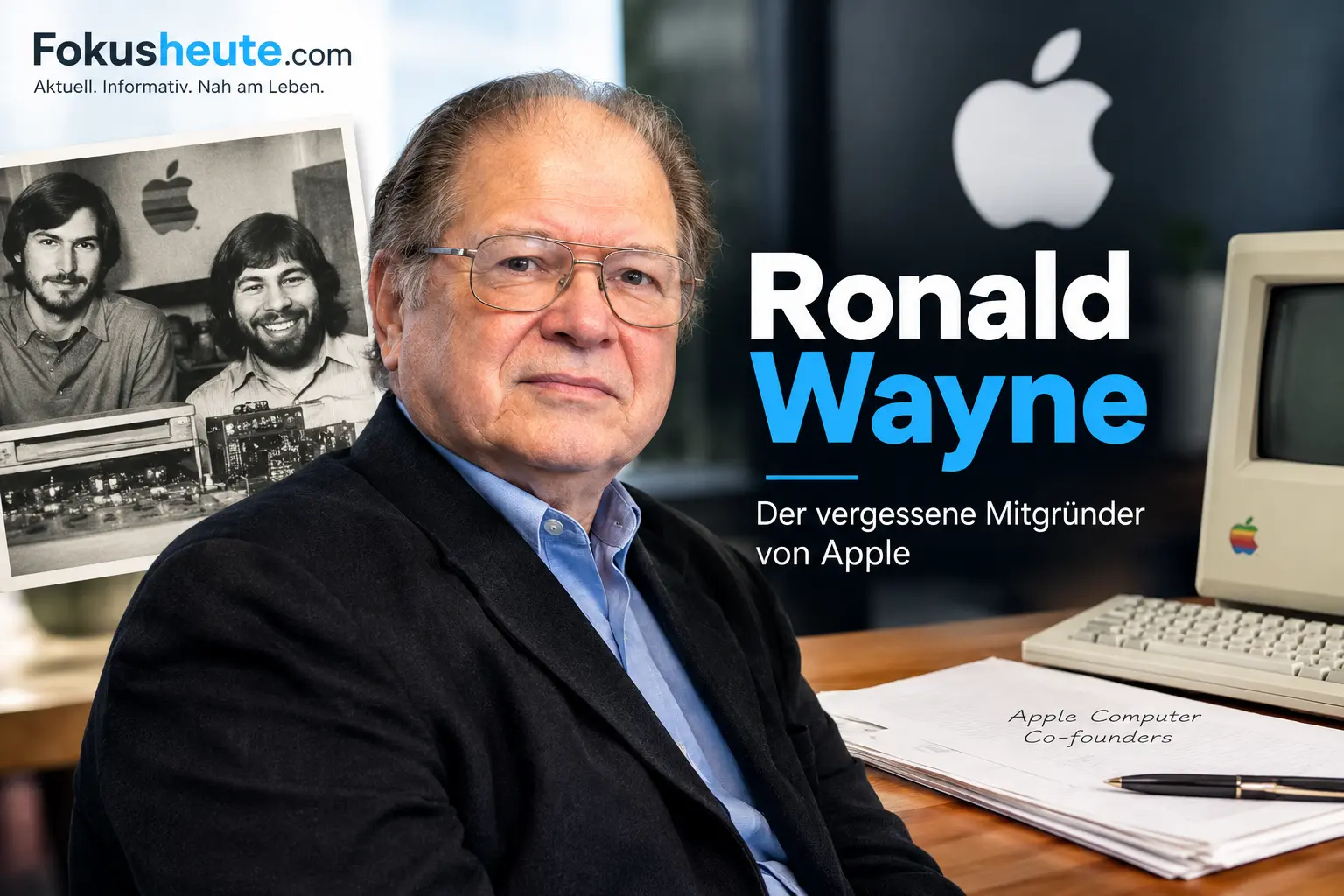
Ronald Wayne is best known as the third co-founder of Apple Computer, the company created with Steve Jobs and Steve Wozniak on April 1, 1976. Although his formal involvement was brief, his early work helped establish the partnership’s legal structure, business documentation, and visual identity. His decision to leave soon afterward became one of the most discussed “what if” stories in technology history.
This guide explains his life, education, engineering career, connection with Atari, contribution to Apple, departure, financial history, later work, public statements, and continuing legacy in clear language. It also separates documented history from estimates and disputed interpretations.
Who Is Ronald Wayne?
Ronald Gerald Wayne is an American engineer, inventor, author, and retired electronics-industry executive. He was born on May 17, 1934, in Cleveland, Ohio, and was raised in New York City. He entered Apple at a very early stage, when it was a small partnership rather than the global corporation known today.
Wayne was older than Jobs and Wozniak and brought practical experience in engineering, documentation, business organization, and risk assessment. He has often been described as Apple’s “forgotten” or “third” co-founder, but that label should not obscure the specific work he performed during the company’s formation.
Ronald Wayne Early Life and Education
Wayne grew up during a period when electronics, mechanical design, and industrial technology were rapidly changing. He studied technical drafting at New York’s School of Industrial Art, where he developed skills in visual communication, geometry, design, and technical plans.
Technical drafting was important because engineers and manufacturers needed precise drawings and documentation to explain how machines, components, and systems should be built. This training later supported Wayne’s work in engineering, product documentation, and business records.
His interest in technology was also strongly self-directed. In later interviews, he has described himself as a curious tinkerer who learned by examining objects, experimenting, and trying to understand how systems worked.
Ronald Wayne’s Career Before Apple
Before Apple, Wayne worked across several technical environments. His professional background included engineering and drafting, work connected with Lawrence Livermore National Laboratory, and positions involving electronic and mechanical systems.
His experience was broader than consumer computers. He worked with technical documentation, manufacturing problems, reliability, and equipment design. This background helps explain why Jobs valued him as someone who could provide practical business and organizational guidance.
Wayne also attempted an early business venture involving slot machines. The experience was difficult and influenced how he thought about commercial risk, personal liability, and the responsibilities attached to owning a business.
Ronald Wayne and Atari
Wayne worked at Atari during the company’s early growth, serving in a technical and product-development environment. Atari was a significant meeting point between engineering, entertainment electronics, and the emerging personal-computing culture.
Steve Jobs worked at Atari before Apple was founded, and the two men became acquainted there. Wayne’s greater age and professional experience gave him a different perspective from the younger Jobs and Wozniak. Accounts of the period often portray Wayne as a stabilizing, experienced voice, although descriptions such as “adult in the room” are best treated as a characterization rather than a formal job title.
His Atari experience exposed him to product development, documentation, manufacturing realities, and the challenges of turning an idea into a functioning commercial operation.
How Ronald Wayne Became an Apple Co-Founder
Apple Computer was established on April 1, 1976, by Steve Jobs, Steve Wozniak, and Ronald Wayne. Jobs and Wozniak supplied the central technical and entrepreneurial drive, while Wayne helped structure the partnership and document the arrangement.
The original business was small, uncertain, and financially exposed. It did not yet have the resources, legal protections, or predictable revenue associated with a mature corporation. Wayne’s participation was therefore connected not only to opportunity but also to the legal and financial obligations of a general partnership.
Ronald Wayne, Steve Jobs, and Steve Wozniak
The three founders brought different strengths. Steve Wozniak was the principal engineering talent behind the early computer designs. Steve Jobs focused heavily on product direction, sales, presentation, and commercial opportunity. Wayne contributed age, professional experience, documentation, and a more cautious view of business exposure.
Their partnership was not an equal three-way division. The commonly reported arrangement gave Wayne a 10 percent interest, while Jobs and Wozniak each held 45 percent. That arrangement existed within the original partnership context and should not be confused with a permanent ownership position in the later incorporated company.
Ronald Wayne’s Role in Apple’s Founding
Wayne’s contribution was practical rather than symbolic. He helped prepare the original partnership agreement and supported the administrative foundation of the new business.
· Preparing and organizing the original partnership documentation.
· Helping clarify responsibilities and business relationships.
· Providing experience that Jobs and Wozniak did not yet possess.
· Contributing written and visual material during Apple’s earliest stage.
· Thinking about commercial and legal risks associated with a general partnership.
This work mattered because a startup needs more than a technical invention. It also needs agreements, records, responsibilities, and a workable method for making decisions.
Ronald Wayne’s Original Apple Partnership Agreement
The original agreement is one of the most important surviving documents connected with Apple’s creation. It recorded the relationship among Jobs, Wozniak, and Wayne at the partnership stage.
A general partnership can expose individual partners to liabilities beyond the amount they personally invest. That distinction is central to understanding Wayne’s later decision. A person’s percentage ownership does not necessarily define the full extent of their legal exposure when a business is structured as a general partnership.
The document has also become a valuable historical artifact. Its importance comes from the fact that it captures Apple before the company became a major corporation and before its future success was apparent.
Ronald Wayne’s Contribution to Apple
Wayne’s early Apple contribution included business documentation and design-related work. He is widely associated with the original Apple logo, a detailed illustration showing Isaac Newton beneath an apple tree, and with early Apple documentation.
The first logo should not be confused with the later rainbow Apple symbol designed by Rob Janoff. Wayne’s logo belonged to Apple’s earliest identity and was soon replaced because it was too detailed for practical reproduction at small sizes.
Wayne’s contribution illustrates how early companies often rely on people who work across several functions. He was not simply a shareholder; he helped translate an informal idea into a documented business structure.
Ronald Wayne and Apple’s First Logo
The original logo attributed to Wayne was an intricate, engraved-style illustration of Isaac Newton under an apple tree. It included decorative detail and text, making it visually different from the simple bitten-apple mark that became famous later.
The design reflected an intellectual and historical association with discovery and insight. However, a highly detailed image was not ideal for circuit boards, packaging, labels, and small printed materials. Apple therefore moved toward a simpler visual identity.
The logo is historically important because it represents Apple before the company developed its recognizable global branding system.
Ronald Wayne and the Apple I Manual
Wayne is also associated with early technical and operational documentation connected with the Apple I. Manuals were important in the early personal-computer market because users often had to assemble, configure, troubleshoot, and understand equipment themselves.
Clear documentation could reduce confusion, communicate technical information, and make a product easier to sell. Wayne’s drafting and documentation background made this type of work a natural part of his contribution.
Historical accounts differ on how specific tasks should be attributed, so claims about individual documents should be checked against primary material, museum records, and Wayne’s own recollections.
Why Did Ronald Wayne Leave Apple?
Wayne left the Apple partnership only a short time after its formation, commonly described as 12 days. The central reason given in historical accounts is concern about financial exposure and personal liability.
Jobs and Wozniak were younger and had fewer personal assets at risk. Wayne, by contrast, had accumulated property and financial responsibilities. If the partnership incurred debts or failed to pay obligations, the consequences could potentially reach beyond the amount of money he had invested.
The decision was therefore not simply a judgment that computers were unimportant. It was a risk calculation made before Apple’s future success could reasonably be known.
Ronald Wayne’s Decision to Sell His Apple Shares
Popular accounts usually say that Wayne sold his 10 percent stake for $800 and later received another payment to relinquish any future claim. This summary captures the broad financial outcome commonly reported, but the language needs care.
In 2026, Wayne publicly challenged the wording that he had “sold” his stake, saying that he did not view the transaction as a conventional sale of shares. The legal and historical distinction is that he exited the original partnership and accepted payment associated with ending his interest and claims. The safest explanation is to describe the reported payments, the partnership exit, and Wayne’s later clarification separately.
This distinction matters because Apple was not yet the publicly traded corporation it became later. Talking about the transaction as though Wayne sold modern Apple stock on a stock exchange is inaccurate.
For the latest, updated, and unique information, visit global lending services.
How Much Did Ronald Wayne Sell His Apple Stake For?
The most frequently reported figure is $800, followed by an additional $1,500 payment connected with formally giving up future claims. Some later summaries describe the total as $2,300, while other accounts discuss subsequent settlement arrangements during incorporation.
The exact description depends on which document or historical account is being used. Readers should not treat every simplified internet version as a complete legal history. The key point is that Wayne received a relatively small amount in 1976 in exchange for ending his participation and potential claims in the early business.
The payment should also be understood in its historical context. Apple was a young, uncertain venture, not a company with a predictable multi-trillion-dollar valuation.
Ronald Wayne’s $800 Apple Share Sale Explained
The $800 figure became famous because of the enormous difference between the early payment and the hypothetical value of an equivalent ownership interest in Apple decades later. It is a compelling illustration of hindsight, but it can also oversimplify Wayne’s decision.
Wayne’s concern was not only whether Apple might succeed. It was whether he could tolerate the downside if the business failed. A rational decision can look different when evaluated with information available in 1976 rather than with knowledge of Apple’s later growth.
Wayne has repeatedly indicated that he does not define his life solely by the money he might have gained. His later comments emphasize judgment, clarity, risk awareness, and the circumstances he understood at the time.
What Would Ronald Wayne’s Apple Shares Be Worth Today?
Estimates of what the original 10 percent interest might be worth today are hypothetical and depend on several assumptions: whether the ownership remained intact, how dilution would have affected it, how incorporation changed the ownership structure, how stock splits are treated, and what valuation date is selected.
Media estimates in 2026 have placed the theoretical value in the hundreds of billions of dollars when comparing 10 percent with Apple’s market capitalization. Such figures are not money Wayne actually owned, and they do not represent a realistic claim that he could have retained an unchanged 10 percent position through every financing round, stock issuance, and corporate restructuring.
A useful way to explain the comparison is this: the story shows the scale of Apple’s growth, but it does not prove that a founder could have held the same percentage without dilution or other changes.
Ronald Wayne Net Worth in 2026
There is no universally verified public figure for Ronald Wayne’s current net worth. Online estimates should therefore be treated cautiously, especially when they are based on assumptions, unsourced calculations, or the hypothetical value of the Apple interest he no longer held.
His post-Apple career included engineering and technical work rather than the accumulation of a publicly documented fortune comparable to major technology founders. Reports have described a relatively private lifestyle and income sources that differ substantially from the wealth associated with Apple’s later executives and shareholders.
A responsible biography should distinguish between confirmed assets, reported income, estimates, and hypothetical wealth. A precise net-worth number should not be presented as fact without a credible and current financial source.
Ronald Wayne’s Life After Apple
After leaving Apple, Wayne continued working in engineering and technology-related fields. His career extended across electronics, industrial systems, gaming equipment, and design work. This broader career is important because his life was not defined only by his brief association with Apple.
He worked as a chief engineer and contributed to technical projects involving electronic systems, connectors, cable assemblies, and equipment designed for demanding environments. His work demonstrates a continuing interest in practical engineering rather than celebrity or corporate publicity.
What Is Ronald Wayne Doing Today?
Public information in 2026 describes Wayne as remaining engaged with writing, interviews, historical discussion, and engineering-related interests. His official public biography also describes work connected with precision measurement and instrumentation.
Current-life details should be dated and sourced carefully because public biographies can change and may contain self-reported information. It is more accurate to say that he remains publicly engaged in selected projects and conversations than to imply that every detail of his daily life is known.
His continuing appearances around Apple’s 50th anniversary have renewed interest in his perspective on the company’s founding and on the decision that made him one of technology history’s most discussed former founders.
How Old Is Ronald Wayne in 2026?
Ronald Wayne was born on May 17, 1934. He turned 92 on May 17, 2026. Age calculations should always be tied to the date being used, particularly when an article is updated during the year.
Ronald Wayne and Steve Jobs
Wayne and Jobs met through the technology and gaming environment surrounding Atari. Jobs was much younger, while Wayne had more professional and business experience. Wayne later described his role as offering knowledge and perspective that Jobs did not yet have access to.
Their relationship should not be reduced to a simple story in which Wayne failed to recognize Jobs’ talent. Wayne was making a decision about legal exposure, personal assets, and the uncertainty of a new partnership. Historical accounts also show that the two men’s working relationship continued only briefly in the Apple founding period.
Ronald Wayne’s Interviews and Public Statements
Interviews are especially important when researching Wayne because some details of Apple’s earliest days come from his own recollections. His comments provide first-hand perspective, but recollections made decades after an event should still be compared with contracts, corporate records, and independent historical reporting.
In 2026, Wayne attracted renewed attention by challenging the familiar description that he simply sold his 10 percent Apple stake. He also continued discussing risk, entrepreneurship, engineering, and the difference between financial outcomes and personal judgment.
For strong editorial practice, quote his words accurately, preserve the date and context, and avoid turning a single statement into a claim about every aspect of the historical record.
Ronald Wayne’s Books and Writings
Wayne wrote Adventures of an Apple Founder: Atari, Apple, Aerospace and Beyond, published in 2011. The book places his Apple experience within a much longer life involving engineering, invention, and technical work.
The book is useful because it expands the story beyond the familiar $800 headline. It presents Wayne as a person with a broad professional life, not merely as someone remembered for leaving Apple.
Readers should distinguish between an autobiography, independent biography, archival documents, and later media summaries. Each type of source has a different purpose and level of verification.
Ronald Wayne’s Legacy in Apple History
Wayne’s legacy rests on two connected facts. First, he was present at the formation of Apple and contributed meaningful documentation and design work. Second, his early departure became a lasting example of how decisions made under uncertainty can be judged differently after extraordinary success.
His story raises practical questions for entrepreneurs: What liabilities come with a business structure? How should founders evaluate downside risk? What should be documented before partners begin operating? And how should people judge an old decision without using information that was unavailable at the time?
Apple’s history is often told through Jobs and Wozniak, but understanding Wayne adds detail to the company’s earliest organizational stage. It also shows that innovation depends on legal, operational, and communication work as well as invention.
Ronald Wayne Frequently Asked Questions
Who is Ronald Wayne?
Ronald Gerald Wayne is an American engineer, inventor, author, and co-founder of Apple Computer, alongside Steve Jobs and Steve Wozniak.
Was Ronald Wayne one of Apple’s founders?
Yes. He participated in the original Apple partnership formed on April 1, 1976, and helped prepare its founding documentation.
Why did Ronald Wayne leave Apple?
The principal reason reported is concern about personal financial liability and the risks of a general partnership.
How much did Ronald Wayne receive when he left Apple?
The commonly reported figures are an initial $800 payment and a later $1,500 payment associated with relinquishing future claims, although Wayne has challenged the simplified description that he sold shares.
What was Ronald Wayne’s role at Apple?
He contributed business and partnership documentation, administrative experience, and early design and technical materials.
Did Ronald Wayne design Apple’s first logo?
He is widely credited with the original detailed Apple logo featuring Isaac Newton beneath an apple tree. It was later replaced by a simpler design.
What is Ronald Wayne’s net worth in 2026?
A reliably verified public figure is not available. Online estimates should be treated as uncertain and should not include hypothetical Apple wealth as actual assets.
How old is Ronald Wayne in 2026?
He was born on May 17, 1934, and turned 92 on May 17, 2026.
Does Ronald Wayne regret leaving Apple?
He has publicly said that he does not frame the decision primarily as a regret and has emphasized the information and risks he understood at the time.
What book did Ronald Wayne write?
He wrote Adventures of an Apple Founder: Atari, Apple, Aerospace and Beyond, published in 2011.
Would Ronald Wayne’s original Apple interest be worth billions today?
A hypothetical 10 percent comparison can reach hundreds of billions based on Apple’s market value, but it ignores dilution, restructuring, and the fact that he did not retain the interest.
Conclusion
Ronald Wayne’s story is more complex than the familiar headline about an $800 Apple stake. He helped establish Apple’s original partnership, contributed documentation and design work, and made an early decision shaped by the financial risks he believed he faced. His later career in engineering and writing shows that his life extended far beyond a few days in 1976. The most useful lesson is not simply that he left before Apple became successful. It is that business decisions should be evaluated using the facts, responsibilities, and uncertainties available when the decision was made. That perspective makes the history of Apple’s third co-founder more accurate, more human, and more valuable for modern readers.
For the latest, updated, and unique information, visit when was the ps5 released.