
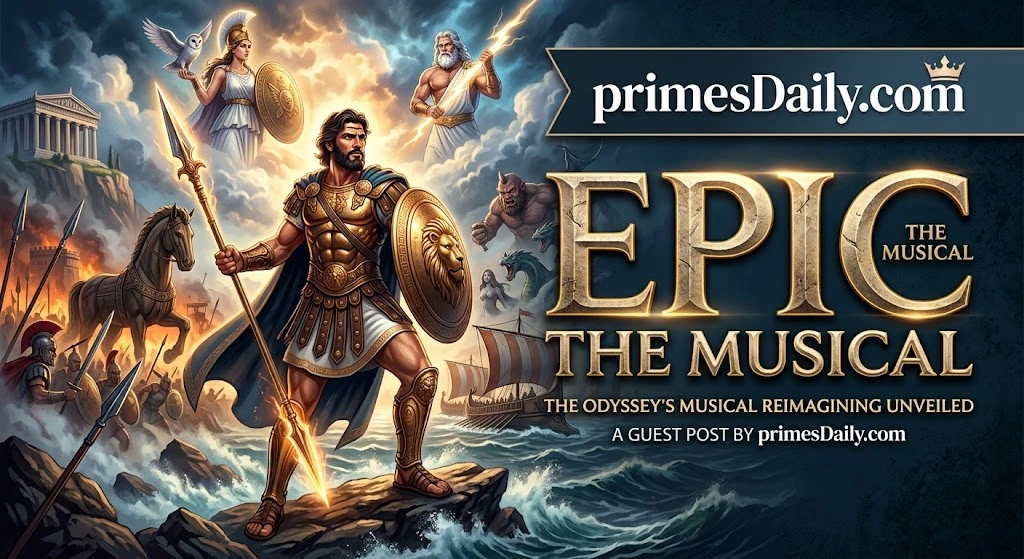
Some musical projects begin on a stage. Others begin with a script, a rehearsal room, and years of traditional development. This one took a very different route. EPIC The Musical grew online as a sung-through retelling of Homer’s Odyssey, combining musical theatre with influences from animation, anime, video games, and modern digital fandom.
If you are completely new to the project, the simplest way to understand it is this: the story follows Odysseus, the king of Ithaca, after the Trojan War. He wants to get home to his wife Penelope and their son Telemachus, but the journey becomes a long chain of encounters with gods, monsters, storms, supernatural forces, enemies, and his own increasingly difficult moral choices.
The finished concept album contains 40 songs arranged into nine story arcs called sagas. It is completely sung-through, so there is no conventional spoken dialogue separating scenes. The music itself carries the plot, character development, conflict, humor, and emotional turning points.
That format makes the project unusually easy to discover but surprisingly deep to understand. A listener can enjoy an individual song without knowing Homer, yet the full experience becomes much richer when the mythology, relationships, timeline, and recurring themes are understood together.
This guide explains the project from the ground up. You will find the saga order, song order, major characters, story timeline, performers, musical ideas, mythology connections, differences from Homer’s Odyssey, ending explanation, fan culture, and practical listening guidance in one place.
What Is EPIC The Musical?
EPIC The Musical is a completely sung-through concept musical written and produced by Puerto Rican singer-songwriter Jorge Rivera-Herrans. It is a loose musical adaptation of Homer’s Odyssey, the ancient Greek epic traditionally attributed to Homer.
Unlike a conventional Broadway-style production that depends on a physical stage, EPIC was developed primarily as a concept album released in separate story installments. Each installment is called a saga. The completed project contains nine sagas and 40 songs, with a total listening time of a little over two hours.
What makes the format distinctive?
The songs do more than provide musical entertainment. They function as scenes. A conversation can become a duet, an argument can become a dramatic ensemble number, an internal conflict can become a solo, and an action sequence can be represented through changes in rhythm, vocal delivery, instrumentation, and sound design.
The project also draws from modern entertainment. Rivera-Herrans has described influences from video games and animation/anime, and those influences are noticeable in the way characters have recognizable musical identities and scenes can shift rapidly between intimate dialogue and cinematic action.
The story is set in the world of Greek heroic mythology, but it is not intended to be a word-for-word musical translation of Homer. It changes emphasis, compresses events, combines ideas, and gives the central character a particularly strong psychological arc.
So, is it a traditional musical or an album?
It is best understood as a concept musical presented through a sequence of studio-recorded songs. Calling it a concept album is accurate, but that label can hide how deliberately the songs are structured as dramatic scenes.
The project also has an important visual side. Fans have created animatics and other interpretations that give listeners different ways to imagine the events. This community-driven visual culture became one of the defining parts of the experience.
Who Created EPIC The Musical?
Jorge Rivera-Herrans is the creator, songwriter, composer, producer, and the principal voice of Odysseus. His creative approach is central to understanding why the project sounds different from a conventional musical.
The idea developed while he was studying at the University of Notre Dame. His interest in musical theatre, Homer’s Odyssey, video games, and animation helped shape the project into a modern musical retelling of an ancient story.
Rivera-Herrans did not simply take a famous myth and place new lyrics over it. He built a musical language around the characters and conflicts. Different relationships and emotional states receive recognizable musical treatment, while the instrumentation becomes more expansive as the story moves deeper into supernatural territory.
He also used online platforms as part of the creative process. Auditions, previews, snippets, production updates, and behind-the-scenes material helped audiences follow the project while it was being developed. That changed the relationship between creator and audience: listeners were not merely waiting for a finished album; many were following the project as it was being made.
The cast was also assembled through an unusually internet-native process, with performers becoming closely associated with the characters they voice. That helped create a strong connection between individual voices, character identities, and the wider fan community.
In short, Rivera-Herrans is not just the person who wrote the songs. He is the central creative force behind the story, music, production, casting direction, and performance identity of the project.
Is EPIC The Musical Based on The Odyssey?
Yes. The story is a loose adaptation of Homer’s Odyssey, but it should not be treated as a direct musical translation of the ancient poem.
The basic journey remains recognizable. Odysseus has spent years fighting in the Trojan War and then attempts to return to Ithaca. The journey home is interrupted by supernatural and human dangers, including the Cyclops, the sea god Poseidon, Circe, the Underworld, Scylla, Calypso, and the dangers surrounding his eventual return.
The important difference is emphasis.
Homer’s poem belongs to an ancient oral and literary tradition with its own structure, values, conventions, and cultural context. The modern musical reshapes that material for a contemporary audience. It places a strong focus on Odysseus as a man confronting the consequences of leadership, violence, loyalty, love, fear, and survival.
The musical also changes or compresses some events. Certain characters receive more emotional attention, some encounters are streamlined, and some relationships are developed through recurring musical themes rather than long narrative passages.
Why make those changes?
A stage or album musical has different storytelling limits from an ancient epic. A listener needs to understand emotional stakes quickly. Songs need clear dramatic purposes. Characters need memorable voices and musical identities. The adaptation therefore selects elements of the source material that support its central themes.
This means you do not need to read Homer before listening. Knowing the original poem can add context, but the musical is designed to work as its own story.
EPIC The Musical Sagas in Order
The story is divided into nine sagas. The first five belong to Act 1 and the final four belong to Act 2.
The saga structure is useful because it gives listeners natural stopping points. Each arc focuses on a particular stage of the journey while advancing the larger homecoming story.
Troy Saga
The Troy Saga introduces the central conflict and establishes the moral burden that will follow Odysseus.
The Trojan War is ending, and Odysseus has to confront a decision that immediately shows why this story is not simply a heroic adventure. Victory does not automatically make him feel like a hero. He is forced to consider the consequences of violence and the kind of future he is creating.
The opening songs establish several important ideas: leadership, family, war, strategy, Athena’s influence, and the tension between being a successful warrior and being a good man.
The major songs are:
The Horse and the Infant
Just a Man
Full Speed Ahead
Open Arms
Warrior of the Mind
The Troy Saga matters because it plants the seeds for almost everything that follows. The listener sees Odysseus as intelligent and capable, but also vulnerable to fear, pride, and difficult decisions.
Cyclops Saga
The Cyclops Saga moves the story from the aftermath of war into the dangerous journey home.
Odysseus and his crew encounter Polyphemus, a Cyclops whose island becomes the setting for one of the most important tests of Odysseus’s leadership.
The major songs are:
Polyphemus
Survive
Remember Them
My Goodbye
This arc introduces a key problem: cleverness can save lives, but arrogance can create new enemies.
The encounter with Polyphemus is especially important because Odysseus is not dealing with an ordinary opponent. The conflict tests his ability to balance strategy, mercy, pride, and survival.
Ocean Saga
The Ocean Saga expands the supernatural side of the journey.
Odysseus and his crew face the unpredictable power of the sea and become increasingly aware that their greatest threats are not always creatures they can fight directly.
The major songs are:
Storm
Luck Runs Out
Keep Your Friends Close
Ruthlessness
The relationship between Odysseus and Poseidon becomes especially important here. The sea is no longer just a setting. It becomes an expression of consequence and danger.
The saga also explores trust. Odysseus must manage a crew that is becoming tired, frightened, and increasingly uncertain about whether following him will actually get them home.
Circe Saga
The Circe Saga introduces one of the most recognizable figures from Greek mythology: Circe.
Circe is not presented simply as a magical obstacle. Her encounter with Odysseus creates a more complicated situation involving transformation, temptation, intelligence, and negotiation.
The major songs are:
Puppeteer
Wouldn’t You Like
Done For
There Are Other Ways
This saga also introduces Hermes in a memorable way. His role adds humor and energy while providing Odysseus with knowledge that helps him navigate a supernatural threat.
The central question is not merely whether Odysseus can defeat Circe. It is whether he can understand the situation well enough to survive without making the wrong kind of bargain.
Underworld Saga
The Underworld Saga is one of the most emotionally important sections.
Odysseus enters a realm associated with the dead and receives information that forces him to confront memories, losses, and consequences.
The major songs are:
The Underworld
No Longer You
Monster
The emotional direction changes sharply here. Earlier sections often focus on external obstacles. This saga turns attention toward what Odysseus is becoming internally.
The appearance of Tiresias gives the story another layer of prophecy and uncertainty. The future is not presented as a simple map that Odysseus can follow. Instead, knowledge becomes another burden.
“Monster” is particularly important because it makes the audience confront a difficult question: what happens when survival changes the person who is trying to survive?
Thunder Saga
The Thunder Saga brings the consequences of the crew’s actions to a devastating point.
Its major songs are:
Suffering
Different Beast
Scylla
Mutiny
Thunder Bringer
Scylla is one of the most important encounters in the entire journey because the danger is not simply about defeating a monster. Odysseus has to make choices about who can survive.
The crew’s frustration also reaches a breaking point. Leadership becomes increasingly isolated, and the gap between Odysseus and Eurylochus becomes impossible to ignore.
The saga ultimately leads to Zeus forcing another brutal decision. The story makes clear that power at sea is not enough to protect a leader from divine judgment.
Wisdom Saga
The Wisdom Saga shifts much of the focus toward Ithaca, Telemachus, Athena, and the possibility of Odysseus returning.
The major songs are:
Legendary
Little Wolf
We’ll Be Fine
Love in Paradise
God Games
Telemachus has grown up without his father and now faces the suitors who occupy his home. He wants to become strong enough to protect his mother and live up to the image of the father he barely knows.
Athena also returns to the center of the story. Her relationship with Odysseus is complicated by their past disagreement, and her connection with Telemachus gives her another reason to act.
The “God Games” sequence is particularly important because Athena must persuade several Olympians that Odysseus deserves to be freed. The scene turns argument into musical competition, allowing each god to represent a different perspective on Odysseus.
Vengeance Saga
The Vengeance Saga marks another major stage in the return journey.
Its major songs are:
Not Sorry for Loving You
Dangerous
Charybdis
Get in the Water
Six Hundred Strike
Odysseus is now much closer to home, but the journey is still dangerous.
Calypso, Aeolus, Poseidon, and the sea itself remain connected to the broader problem of whether Odysseus can finally break away from the forces that have controlled his journey.
The emotional emphasis is on determination and confrontation. The man who left Troy is not the same person who is trying to reach Ithaca.
Ithaca Saga
The Ithaca Saga brings the long journey to its conclusion.
Its five songs are:
The Challenge
Hold Them Down
Odysseus
I Can’t Help But Wonder
Would You Fall in Love with Me Again
This arc returns the story to the human heart of the project: home, family, identity, and the meaning of coming back after years of absence.
The suitors represent a threat inside Odysseus’s own kingdom. Telemachus has become a young man, Penelope has waited for years, and Odysseus must determine what kind of king and husband he can be after everything he has experienced.
The final songs deliberately move away from the spectacle of monsters and gods and toward emotional resolution.
EPIC The Musical Songs in Order
The complete project contains 40 songs. Listening in release order is also the best way to follow the story because the tracks are arranged as connected scenes rather than independent singles.
Troy Saga Songs
The Horse and the Infant
Just a Man
Full Speed Ahead
Open Arms
Warrior of the Mind
Cyclops Saga Songs
Polyphemus
Survive
Remember Them
My Goodbye
Ocean Saga Songs
Storm
Luck Runs Out
Keep Your Friends Close
Ruthlessness
Circe Saga Songs
Puppeteer
Wouldn’t You Like
Done For
There Are Other Ways
Underworld Saga Songs
The Underworld
No Longer You
Monster
Thunder Saga Songs
Suffering
Different Beast
Scylla
Mutiny
Thunder Bringer
Wisdom Saga Songs
Legendary
Little Wolf
We’ll Be Fine
Love in Paradise
God Games
Vengeance Saga Songs
Not Sorry for Loving You
Dangerous
Charybdis
Get in the Water
Six Hundred Strike
Ithaca Saga Songs
The Challenge
Hold Them Down
Odysseus
I Can’t Help But Wonder
Would You Fall in Love with Me Again
A useful beginner tip is to avoid shuffling the album on a first listen. The project is written like a continuous narrative, so changing the order can remove important setup and make later emotional moments confusing.
EPIC The Musical Characters
The cast is large because the story moves between mortals, gods, monsters, spirits, sailors, and the people waiting in Ithaca.
The most important characters are not equally present. Some drive the central plot, while others appear for one major encounter and leave a lasting effect.
Odysseus
Odysseus is the king of Ithaca, husband of Penelope, father of Telemachus, former captain of the Greek forces, and the story’s central protagonist.
His defining strength is his intelligence. He is a strategist rather than a warrior who depends only on physical power.
But intelligence does not make him morally simple. He repeatedly has to decide how much violence, deception, sacrifice, or ruthlessness he is willing to accept in order to reach home.
That tension is the heart of his character.
Penelope
Penelope is Odysseus’s wife and Telemachus’s mother. Her role is closely connected to loyalty, patience, intelligence, and the idea of home.
Although she does not dominate the number of songs, her presence gives Odysseus’s journey its emotional destination. He is not traveling home merely because Ithaca is his kingdom. He wants to return to his family.
Telemachus
Telemachus is the son of Odysseus and Penelope.
He has grown up with an absent father and must deal with the consequences of that absence. His storyline is about becoming capable without simply copying his father.
His relationship with Athena is also important. She becomes a mentor figure for him, creating a connection between the younger generation and the heroic world that shaped Odysseus.
Athena
Athena is the goddess of wisdom and strategy and one of the most important divine figures in the story.
Her relationship with Odysseus begins as a mentorship based on intelligence and strategic thinking. Their eventual conflict is therefore personal as well as philosophical.
Athena also develops a meaningful relationship with Telemachus. Through him, she gets another perspective on what Odysseus means to a family.
Poseidon
Poseidon is the god of the sea and one of the most formidable forces opposing Odysseus.
His conflict with the king of Ithaca turns the ocean journey into a personal struggle. Poseidon represents the danger of provoking a power that cannot simply be outsmarted.
His presence also reinforces one of the story’s major ideas: actions have consequences, and some consequences can follow a person much farther than expected.
Zeus
Zeus is the king of the Olympian gods and a major source of divine authority.
He appears at crucial points when human decisions collide with the interests of the gods. His role is particularly important in the story’s questions about judgment, power, sacrifice, and whether mortals deserve mercy.
Eurylochus
Eurylochus is one of Odysseus’s closest companions and a major voice within the crew.
He is important because he does not always agree with Odysseus. Their disagreements make the story’s leadership conflict feel personal rather than abstract.
Polites
Polites represents a more optimistic approach to the journey. His belief in open-heartedness provides an important contrast with Odysseus’s increasingly defensive worldview.
His fate also helps show how the harshness of the journey changes the protagonist.
Circe
Circe is a powerful enchantress whose encounter with Odysseus is based on the famous transformation episode from Greek mythology.
The musical gives her more emotional complexity than a simple villain role. Her scenes explore power, attraction, negotiation, and the ability of two intelligent people to recognize one another.
Calypso
Calypso becomes central during the period when Odysseus is trapped away from home.
Her role raises difficult questions about isolation, consent, longing, and the difference between being offered comfort and actually being free.
Tiresias
Tiresias is a prophetic figure associated with the Underworld. His encounter with Odysseus introduces information about the future while also forcing the protagonist to think about what his journey is doing to him.
Polyphemus
Polyphemus is the Cyclops encountered by Odysseus and his crew.
He represents one of the story’s clearest examples of how a seemingly successful strategy can create a much larger problem.
Scylla
Scylla is a sea monster whose appearance creates one of the harshest moral decisions in the story.
Her role is not simply “monster attacks heroes.” The scene is designed to make the audience think about leadership under impossible circumstances.
The Suitors
The suitors are the men occupying Odysseus’s household in Ithaca while he is absent.
They are especially important in the final part of the story because they represent the threat waiting at home. The danger is no longer a distant monster or divine force; it is inside Odysseus’s kingdom.
Odysseus in EPIC The Musical
Odysseus is best understood as a character who changes rather than a hero who simply succeeds.
At the beginning, he is a confident strategist. He knows how to solve problems and is comfortable making difficult decisions.
The problem is that every solution carries a price.
The Trojan War introduces him to moral compromise. The Cyclops encounter teaches him that cleverness can become arrogance. The sea journey tests his leadership. The Underworld forces him to confront the person he is becoming. The Scylla encounter makes sacrifice brutally concrete. By the time he approaches Ithaca, survival has transformed him.
One of the strongest questions running through his story is: when does a man become a monster?
That question is not answered by a single action. It is explored repeatedly through the choices Odysseus makes.
His character also has two competing identities. He is a king and a husband, a strategist and a survivor, a father and a warrior. Those identities do not always point toward the same decision.
This is why the final return matters. Getting home is not enough. He has to discover whether the person who returns can still belong to the life he left behind.
Penelope in EPIC The Musical
Penelope is the emotional center of the homecoming narrative.
She represents the life Odysseus is trying to recover, but she is not simply a passive reward waiting at the end of the journey. Her long absence from the main adventure is itself meaningful because she has been living through the consequences of Odysseus’s absence.
Her relationship with the suitors shows the pressure placed on Ithaca while the king is gone. Her patience and determination become part of the story’s larger discussion of loyalty.
The final emotional question is therefore larger than “Does Odysseus get home?” It is “After all these years, can these two people still recognize each other?”
That question gives the ending much more emotional weight than a simple victory scene.
Telemachus in EPIC The Musical
Telemachus represents the next generation.
He knows his father mainly through memory, reputation, and the expectations placed on him as the prince of Ithaca. He wants to protect his mother, but he also feels inadequate because he has not grown into the legendary figure everyone associates with his father.
His journey is about confidence.
The Wisdom Saga allows him to move from frustration toward action. His relationship with Athena gives him guidance while still allowing him to develop his own identity.
Telemachus is important because the story does not suggest that the son must become another Odysseus. Instead, he can become strong in a different way.
For the latest, updated, and unique information, visit fokusheute.com.
Athena in EPIC The Musical
Athena embodies wisdom, strategy, intelligence, and divine power, but her relationship with Odysseus also reveals the limitations of pure strategy.
She initially values his ability to think several moves ahead. Their relationship becomes strained when Odysseus makes choices that conflict with her expectations.
Her later connection with Telemachus changes her perspective. She sees the human consequences of the distance between Odysseus and his family.
The Wisdom Saga therefore gives Athena a meaningful character arc of her own. She moves from judging Odysseus to reconsidering what she understands about him.
Poseidon in EPIC The Musical
Poseidon represents an almost overwhelming form of consequence.
As god of the sea, he controls the environment through which Odysseus must travel. That gives him an advantage no mortal strategist can fully eliminate.
His conflict with the protagonist also illustrates the difference between human intelligence and divine power. Odysseus can outthink many opponents, but he cannot simply reason the ocean into submission.
The character also adds a sense of scale. The journey is not just a series of personal problems; it takes place inside a world where gods can directly alter mortal lives.
Zeus in EPIC The Musical
Zeus represents judgment and authority.
He is not simply an obstacle who appears because the story needs another villain. His decisions force Odysseus and the other characters to confront the consequences of their actions.
His role becomes especially important when the story asks whether the needs of the many justify the sacrifice of individuals.
Zeus also creates one of the most memorable divine sequences when Athena must argue for Odysseus’s freedom.
EPIC The Musical Story Explained
At its simplest, the story is a homecoming.
Odysseus has fought in the Trojan War for years and wants to return to Ithaca. The journey should be straightforward after the war ends, but mythological forces repeatedly prevent him from reaching home.
The first major moral crisis comes immediately after Troy. Odysseus wins the war but is confronted with the terrible consequences of victory. This establishes the pattern that continues throughout the musical: success does not mean innocence.
The crew then encounters Polyphemus. Odysseus survives through intelligence, but the encounter contributes to later consequences.
At sea, Poseidon becomes a major threat. Odysseus and his crew are pushed into increasingly dangerous situations, and trust inside the crew begins to weaken.
Circe introduces another kind of challenge. The danger is psychological and supernatural rather than purely physical. Odysseus must understand his opponent instead of simply overpowering her.
The Underworld then forces him to confront what he has lost and what he may become.
The journey becomes more brutal. Scylla forces a terrible choice. The crew mutinies. Zeus demands another sacrifice. Eventually Odysseus is separated from his companions.
Meanwhile, Ithaca has its own story. Penelope waits, Telemachus grows up, and the suitors take advantage of Odysseus’s absence.
Athena returns to the story and helps Telemachus. She eventually discovers that Odysseus is still alive but trapped on Ogygia with Calypso.
After the gods intervene, Odysseus resumes his journey. He faces the final sea dangers and reaches Ithaca.
The final arc is not about whether he can physically return. It is about what happens after he returns.
He has changed. His family has changed. Ithaca has changed. The ending therefore focuses on recognition, trust, love, identity, and the possibility of rebuilding a relationship after years of separation.
EPIC The Musical Timeline
The timeline can be easier to understand when reduced to major stages.
1. The Trojan War
Odysseus serves as a Greek leader during the war against Troy.
2. The Fall of Troy
The Greeks win, and Odysseus begins the journey home.
3. The First Moral Burden
The aftermath of Troy establishes the darker side of victory and leadership.
4. The Cyclops Encounter
Odysseus and his crew meet Polyphemus and escape through strategy.
5. The Sea Journey
The crew faces storms, supernatural forces, and growing tension.
6. Poseidon’s Opposition
The sea god becomes a major enemy, making the homeward journey far more dangerous.
7. Circe’s Island
The crew encounters Circe and must navigate her supernatural power.
8. The Underworld
Odysseus receives prophetic and emotional revelations about the journey.
9. Scylla and the Crew’s Collapse
The journey reaches a point where Odysseus’s leadership becomes increasingly difficult to defend.
10. Zeus’s Judgment
The crew pays a devastating price for its actions.
11. Ithaca Without Odysseus
Penelope and Telemachus face the suitors while waiting for the king’s return.
12. Athena and Telemachus
Athena begins repairing her relationship with Odysseus’s family.
13. Odysseus on Ogygia
Odysseus remains trapped with Calypso and becomes desperate to escape.
14. The God Games
Athena argues that Odysseus should be freed.
15. The Final Sea Journey
Odysseus confronts the remaining dangers between himself and home.
16. Return to Ithaca
He reaches his kingdom and faces the suitors.
17. Family Reunion
The final songs focus on whether Odysseus and his family can rebuild their relationship after years apart.
EPIC The Musical Cast and Voice Performers
The concept album became strongly associated with its performers because the voices are part of the characters’ identities.
Jorge Rivera-Herrans performs Odysseus and also voices several additional parts, including Polyphemus and other ensemble roles.
Luke Holt performs Zeus and Elpenor.
Armando Julián performs Eurylochus.
Steven Dookie performs Polites.
Teagan Earley performs Athena.
Kira Stone performs Aeolus.
Steven Rodriguez performs Poseidon.
Talya Sindel performs Circe.
Troy Doherty performs Hermes.
Anna Lea performs Penelope and the Sirens.
Miguel Veloso, also known as MICO, performs Telemachus.
Wanda Herrans performs Anticlea.
Mason Olshavsky performs Tiresias.
KJ Burkhauser performs Scylla.
Barbara Wangui performs Calypso.
Other performers contribute voices for Apollo, Hephaestus, Aphrodite, Ares, Hera, the suitors, and ensemble characters.
One reason the casting works so well is that the performances are not simply spoken character voices. Each performer has to communicate personality through singing, rhythm, harmonies, dramatic timing, and vocal contrast.
EPIC The Musical Soundtrack and Music
The soundtrack is designed as narrative music.
Instead of stopping the story to insert a song, the project uses songs as the story. That is why the term “sung-through” is so important.
The musical language also changes with the setting and emotional stakes.
Early sections often feel more grounded in human conflict. As gods, monsters, and supernatural events become more prominent, the sound can become larger, stranger, or more electronic.
The project draws from multiple musical influences rather than staying inside one genre. You can hear theatrical writing alongside pop, rock, electronic production, cinematic textures, and other modern influences.
Another important technique is musical repetition.
Characters and ideas can return through similar melodic shapes, rhythms, vocal patterns, or production choices. That gives the story continuity even when the location changes.
For a first-time listener, this means the soundtrack is worth hearing in order rather than as a collection of unrelated songs.
EPIC The Musical Themes and Symbolism
Home
Home is the obvious goal, but it becomes more complicated as the story continues.
Odysseus begins by thinking about Ithaca as a destination. Later, the audience realizes that home also means identity, family, memory, and belonging.
Leadership
The story repeatedly asks what a leader owes to the people following him.
Odysseus has authority, but authority does not make every decision morally correct.
Ruthlessness
Survival sometimes requires brutal choices. The musical explores whether necessary violence can gradually become an identity.
Love and Loyalty
Penelope’s waiting, Telemachus’s attachment to his parents, Odysseus’s desire to return, and Athena’s complicated loyalty all show different forms of devotion.
Wisdom
Intelligence can solve problems, but intelligence without humility can create new ones.
Fate and Free Will
Prophecies appear throughout the journey, but characters still make choices.
This creates a central tension: if the future is partly known, how responsible is a person for what happens?
Sacrifice
The story repeatedly places characters in situations where someone must lose something so another person can survive.
The important point is that sacrifice is never treated as emotionally neutral.
Identity
Odysseus is simultaneously king, husband, father, soldier, strategist, and survivor. The journey tests which identity will remain when he finally gets home.
EPIC The Musical vs. The Odyssey
The modern musical and Homer’s Odyssey share the same broad narrative foundation, but they are not identical works.
The ancient poem is part of a much older literary tradition and contains extensive narrative detail, cultural context, divine intervention, storytelling within storytelling, and epic conventions.
The modern adaptation compresses the material into songs and prioritizes a focused emotional journey.
One major difference is pacing. A long ancient epic can spend substantial time describing events, speeches, genealogies, journeys, and cultural customs. A modern concept album has to communicate a scene in minutes.
Another difference is character emphasis.
The musical places strong attention on Odysseus’s psychology and on relationships such as Odysseus and Athena, Odysseus and Penelope, and Athena and Telemachus.
The musical also uses modern sound design and theatrical conventions that did not exist in Homer’s world.
That does not make one version “correct” and the other “incorrect.” Adaptation means selecting what to preserve and what to reinterpret.
For someone discovering the story through the musical, the best approach is to treat it as its own version of the Odyssey while recognizing the ancient source behind it.
EPIC The Musical Ending Explained
Spoiler warning: this section discusses the final saga and the ending.
The final part of the story brings Odysseus back to Ithaca, but the physical return is only the beginning of the emotional resolution.
The suitors have taken over the household and threaten Penelope’s future. Telemachus has also grown into a young man who can no longer remain passive.
Odysseus must confront the people who have abused his absence and challenged his family’s position.
The song “Odysseus” presents a darker and more intimidating version of the protagonist. The man who began the story as a clever strategist has become someone capable of frightening violence.
That transformation is deliberate. The audience has spent the entire journey asking whether survival has turned him into the monster he feared becoming.
The final songs then move toward the personal relationship between Odysseus and Penelope.
The emotional climax is not simply revenge against the suitors. It is recognition.
After years apart, can Penelope trust that the man who returned is still the husband she remembers?
That is why the final song, “Would You Fall in Love with Me Again,” is so important. It reframes the entire homecoming. Odysseus does not only want his kingdom back. He wants to know whether his marriage can survive the person he has become.
The ending therefore completes the central theme: the journey home was both physical and psychological.
Why Is EPIC The Musical So Popular?
Its popularity comes from several factors working together.
First, the story is instantly recognizable. Greek mythology already has a large global audience, and the Odyssey provides a familiar foundation without requiring listeners to know every detail.
Second, the music is designed for emotional impact. Songs can work independently while still contributing to a continuous narrative.
Third, the project developed online. Audiences could watch previews, follow production updates, discover performers, discuss theories, and create their own interpretations.
Fourth, the characters are easy to connect with. Even when the story becomes supernatural, its central problems remain human: family, loneliness, leadership, guilt, ambition, loyalty, and the desire to return home.
Fifth, the animatic culture gives the project a visual dimension. Different artists can interpret the same song differently, allowing fans to experience multiple versions of the same scene.
Finally, the project sits at an interesting intersection of musical theatre, mythology, internet culture, animation, gaming influences, and modern music. That makes it accessible to audiences who may not normally consider themselves musical-theatre fans.
Where to Listen to EPIC The Musical
The complete concept album is available through major music streaming services.
For the clearest first listen, use the official full-album sequence rather than a random playlist. The project is designed to be heard as a continuous story.
A good beginner approach is:
Listen to the Troy Saga without reading explanations.
Continue through the Cyclops and Ocean Sagas.
Pay attention to how Odysseus changes rather than only what happens.
Continue through Circe and the Underworld.
Listen to the Thunder Saga carefully because it changes the emotional direction of the story.
Continue into Wisdom and Vengeance.
Finish with Ithaca before reading detailed ending discussions.
If you prefer visual storytelling, you can pair the songs with fan-made animatics. Just remember that animatics are individual artists’ interpretations, not one single official visual version of the entire musical.
The official project has also released individual saga albums and physical editions, so listeners have several ways to experience the music.
EPIC The Musical Animatics and Fan Community
The fan community is one of the project’s most distinctive features.
Because the story is delivered through songs rather than a completed traditional stage production, fans have created their own visual interpretations. These are commonly called animatics: edited sequences of drawings, animation, storyboards, character art, motion, and effects synchronized to the songs.
Why are animatics important?
They help listeners visualize scenes that the audio leaves open to interpretation. One artist may imagine a character in a realistic mythological style, while another may use anime-inspired designs, graphic-novel aesthetics, or a completely original visual language.
This creates a remarkable situation in which the same song can have many visual identities.
The community also produces covers, fan art, memes, analysis, theories, character discussions, cosplay, and other creative work.
For new listeners, this can be both exciting and overwhelming. A simple rule helps: listen to the official music first, then explore fan interpretations afterward. That lets you form your own mental picture before seeing how other people imagined the same scene.
The online development model also helped the audience feel involved in the creation process. Updates, snippets, casting announcements, and production discussions made the project feel like a journey shared between creator and listeners.
EPIC The Musical and Greek Mythology
The musical draws heavily from Greek mythology, but understanding a few mythological ideas makes the story easier to follow.
Odysseus
In Greek mythology, Odysseus is the king of Ithaca and the hero of the Odyssey. He is famous for intelligence, strategy, and his long journey home after the Trojan War.
Penelope
Penelope is Odysseus’s wife and is traditionally associated with loyalty, patience, intelligence, and her resistance to the suitors.
Telemachus
Telemachus is the son of Odysseus and Penelope. His coming-of-age story is an important part of the Odyssey.
Athena
Athena is the Greek goddess associated with wisdom and strategic warfare. She has a strong connection with Odysseus in many traditions.
Poseidon
Poseidon is the god of the sea. His opposition to Odysseus is one of the central forces driving the long journey.
Circe
Circe is a powerful enchantress famous for transforming Odysseus’s men into animals in the Odyssey tradition.
Hermes
Hermes is the messenger of the gods and a recurring helper figure in Greek mythology.
Tiresias
Tiresias is a famous prophet whose appearance connects the living world with knowledge of the dead and the future.
Scylla and Charybdis
These are two legendary sea dangers associated with Odysseus’s voyage. They represent different forms of peril that sailors must navigate.
Calypso
Calypso is a divine figure associated with Odysseus’s long stay on Ogygia.
Zeus
Zeus is the king of the Olympian gods and the god of the sky and thunder.
The important thing to remember is that the musical uses these mythological figures as part of its own adaptation. Their traditional identities provide the foundation, but their characterization, dialogue, relationships, and musical roles belong to this modern interpretation.
FAQs
What is EPIC The Musical?
It is a completely sung-through concept musical by Jorge Rivera-Herrans that loosely adapts Homer’s Odyssey. The story follows Odysseus as he tries to return to Ithaca after the Trojan War.
How many songs are in the complete musical?
There are 40 songs arranged across nine sagas.
How many sagas are there?
There are nine sagas: Troy, Cyclops, Ocean, Circe, Underworld, Thunder, Wisdom, Vengeance, and Ithaca.
Is the musical finished?
The complete concept album has been released across its nine saga installments, making the full 40-song story available.
Is it the same as Homer’s Odyssey?
No. It is a loose adaptation. The central journey and many famous characters and encounters come from the Odyssey, but the modern musical changes pacing, characterization, emphasis, and some story details.
Who plays Odysseus?
Jorge Rivera-Herrans performs Odysseus. He is also the creator and principal creative force behind the project.
Who plays Athena?
Teagan Earley performs Athena.
Who plays Penelope?
Anna Lea performs Penelope.
Who plays Telemachus?
Miguel Veloso, also known as MICO, performs Telemachus.
Who plays Poseidon?
Steven Rodriguez performs Poseidon.
Who plays Zeus?
Luke Holt performs Zeus.
What is the correct listening order?
Start with the Troy Saga and continue through Cyclops, Ocean, Circe, Underworld, Thunder, Wisdom, Vengeance, and finally Ithaca. Within each saga, listen to the songs in their numbered sequence.
Can someone enjoy it without knowing Greek mythology?
Yes. The story is written to work on its own. Basic knowledge of the Odyssey can add context, but a first-time listener does not need a mythology degree to understand the main plot.
What is a saga?
A saga is a group of songs that forms a major narrative section. The nine sagas divide the full story into manageable arcs.
What is a sung-through musical?
A sung-through musical tells its story almost entirely through music rather than conventional spoken dialogue. In this project, songs function as scenes and conversations.
Why are there so many fan animatics?
The audio leaves visual details open to interpretation, and fans have filled that space with their own artwork and animation. This has become a major part of the community surrounding the project.
Is the story only about Odysseus?
Odysseus is the central protagonist, but the story also gives important emotional and narrative roles to Penelope, Telemachus, Athena, Eurylochus, Poseidon, Zeus, Circe, Calypso, and many others.
What is the main theme?
The clearest recurring idea is the cost of trying to get home. The story explores leadership, love, loyalty, survival, violence, identity, family, wisdom, sacrifice, and whether a person can return home after becoming someone different.
Conclusion
EPIC The Musical turns one of the oldest surviving heroic stories into a modern audio-first musical experience.
Its strength is not simply that it retells the Odyssey. It gives the journey a new emotional framework built around songs, recurring musical ideas, internet-native storytelling, memorable characters, and a community that actively creates around the work.
For a new listener, the best starting point is simple: follow the nine sagas in order and let the story unfold before trying to understand every reference. Once the basic journey is clear, the mythology, character relationships, musical motifs, symbolism, and adaptation choices become much easier to appreciate.
The project ultimately asks a very human question beneath all the gods and monsters: after everything that changes us, can we still find our way back to the people and place we call home?
That is what makes the journey worth following from the first song to the final reunion.
For the latest, updated, and unique information, visit Latest News LogicalShout.